
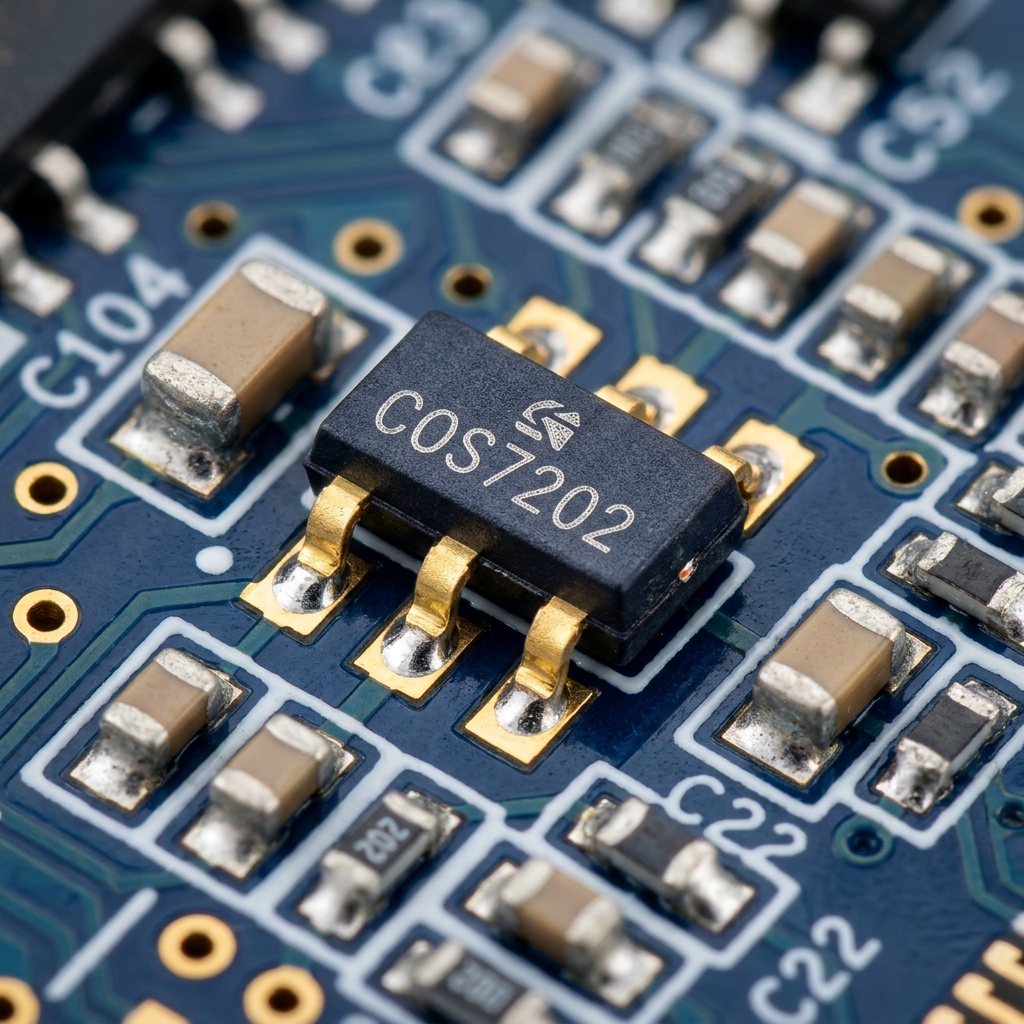
Direct Engineering Conclusion: The COS7202 and COS7212 are monolithic 40V wide-input, low-dropout (LDO) linear voltage regulators engineered for industrial sensors, automotive battery-connected electronics, and precision instrumentation. Delivering up to 300mA of continuous output current with an ultra-low quiescent current of only 55uA under full input voltage stress, the devices maintain low noise (32 uVRMS) and high power supply rejection ratio (PSRR > 70dB at 1kHz). Built-in reverse battery protection, thermal foldback, and short-circuit current limiting provide rugged field survivability against severe supply surges. Serving as pin-to-pin drop-in replacements for the Texas Instruments LP2951, Diodes Incorporated AS1910, and Maxim MAX15007, the COS7202 (SOT-23-5) and COS7212 (SOP-8) provide robust power supply decoupling directly from 24V industrial control loops and 12V/24V commercial vehicle batteries.
The COS7202 and COS7212 are monolithic 40V wide-input, low-dropout (LDO) linear voltage regulators engineered for industrial sensors, automotive battery-connected electronics, and precision instrumentation. Delivering up to 300mA of continuous output current with an ultra-low quiescent current of only 55uA under full input voltage stress, the devices maintain low noise (32 uVRMS) and high power supply rejection ratio (PSRR > 70dB at 1kHz). Built-in reverse battery protection, thermal foldback, and short-circuit current limiting provide rugged field survivability against severe supply surges. Serving as pin-to-pin drop-in replacements for the Texas Instruments LP2951, Diodes Incorporated AS1910, and Maxim MAX15007, the COS7202 (SOT-23-5) and COS7212 (SOP-8) provide robust power supply decoupling directly from 24V industrial control loops and 12V/24V commercial vehicle batteries.
1. Introduction: Clean Voltage Regulation in Harsh 24V Industrial & Automotive Environments
In modern industrial automation, process control instrumentation, and commercial vehicle telematics, electronic control units (ECUs) are exposed to harsh electrical environments characterized by wide supply voltage fluctuations, severe inductive load switching spikes, and substantial common-mode electrical noise. The standard 24V direct current (DC) industrial field bus, while nominally specified at 24V, frequently drifts between 18V and 36V in factory automation networks and can surge past 40V during heavy motor braking or inductive relay de-energization. Similarly, 12V and 24V automotive battery systems are subject to severe ISO 7637-2 electrical transients, including cold-crank voltage dips down to 6V and alternator load dump surges exceeding 36V.
At the same time, the microcontrollers, high-resolution analog-to-digital converters (ADCs), precision operational amplifiers, and radio-frequency (RF) transceivers embedded within these systems require clean, stable, and low-noise supply rails—typically 3.3V or 5.0V—with ripple voltages restricted to the microvolt domain. While switched-mode buck converters offer high energy conversion efficiency when stepping down high voltages, their rapid inductive switching transitions ($f_{sw} \approx 500\,\text{kHz} - 2\,\text{MHz}$) generate unavoidable high-frequency harmonic ripple, switching spikes, and electromagnetic interference (EMI) that degrade the measurement accuracy of sensitive analog sensor front-ends.
The Cosine Nanoelectronics COS7202 and COS7212 low-dropout (LDO) linear regulators deliver the ideal power management solution for these demanding applications. Engineered with a high-voltage 40V bipolar-CMOS-DMOS (BCD) process, the devices withstand continuous input voltages up to 40V while providing ultra-clean, ripple-free regulated outputs with power supply rejection ratios (PSRR) exceeding 70dB at 1kHz. Combining micro-power quiescent consumption ($55\,\mu\text{A}$) with robust internal fault protection, the COS7202 (SOT-23-5) and COS7212 (SOP-8) serve as the premier choice for primary power regulation and post-switching clean rail filtering across global industrial and automotive markets.
2. Silicon Architecture & Low-Drift Bandgap Reference Topology
The internal silicon architecture of the COS7202/COS7212 comprises a curvature-corrected precision bandgap voltage reference, an ultra-low-noise error amplifier, a high-voltage P-channel DMOS (PMOS) power pass transistor, an internal feedback resistor network, and comprehensive fault monitoring circuitry encompassing thermal shutdown, short-circuit current limiting, and reverse battery protection.
At the heart of the regulator lies the curvature-corrected bandgap reference. Conventional bandgap circuits cancel the first-order negative temperature coefficient of a base-emitter junction ($V_{be}$, approximately $-2\,\text{mV/}^\circ\text{C}$) using a proportional-to-absolute-temperature ($V_T = kT/q$) current. However, second-order non-linearities in the silicon bandgap potential cause thermal drift at temperature extremes. The COS7202 incorporates active parabolic curvature compensation circuitry that injects a non-linear correction current at elevated temperatures, achieving an exceptional reference temperature coefficient of less than $15\,\text{ppm/}^\circ\text{C}$ over the full industrial operating range of $-40^\circ\text{C}$ to $+125^\circ\text{C}$.
The output pass element is implemented as a lateral PMOS power transistor rather than a traditional PNP bipolar transistor. In PNP-based LDOs, the base drive current flows directly to ground, causing quiescent current to surge by tens of milliamperes when the regulator enters dropout under heavy load. In contrast, the gate of the PMOS pass element in the COS7202 is driven purely by voltage. Consequently, the quiescent operating current remains virtually flat at $55\,\mu\text{A}$ across all load currents from zero to 300mA and across the entire input voltage span from 3.0V to 40V, maximizing battery runtime in standby telemetry sensors.
3. Comprehensive Parametric Benchmark vs. Industry Standards
To provide electronic manufacturing services (EMS) providers and system architects with uncompromised supply chain security, the COS7202 and COS7212 are designed as 100% pin-compatible, drop-in replacements for industry-standard regulators including the Texas Instruments LP2951, Diodes Inc. AS1910, Maxim Integrated MAX15007, and Texas Instruments TPS7A1601.
As illustrated in the comprehensive parametric comparison in Table 1, the COS7202 delivers significant performance advantages over legacy devices. While the traditional LP2951 is restricted to a maximum continuous input voltage of 30V and an output current of 100mA, the COS7202 expands input survivability to 40V continuous while delivering up to 300mA of load current—a 200% increase in output capability. This expanded current headroom allows engineers to power higher-performance microcontrollers and wireless communication modules (such as Wi-Fi, BLE, and cellular IoT transceivers) from a single compact LDO.
Furthermore, the dropout voltage of the COS7202 is less than $160\,\text{mV}$ at $100\,\text{mA}$ load current, compared to $380\,\text{mV}$ for the bipolar LP2951. This low dropout profile ensures that the regulator maintains full output regulation even when operating from a collapsing battery rail or under deep cold-cranking conditions in automotive electrical networks.
4. Frequency Response, Loop Stability & Output Capacitor Selection
Linear regulator loop stability represents one of the most critical challenges in power supply design. An LDO is a closed-loop negative feedback amplifier where the high output impedance of the PMOS pass transistor forms a dominant low-frequency pole ($p_1$) with the output load capacitance ($C_{out}$) and load resistance ($R_{load}$):
$$f_{p1} = \frac{1}{2\pi \cdot R_{load} \cdot C_{out}}$$As the load current decreases toward zero ($R_{load} \to \infty$), the dominant pole shifts toward very low frequencies, eroding loop phase margin and risking self-sustained oscillation. In older LDO designs, loop stability required a specific equivalent series resistance (ESR) in the output capacitor to create a stabilizing zero ($f_z = 1 / (2\pi \cdot \text{ESR} \cdot C_{out})$), creating severe instability when modern ultra-low-ESR ceramic capacitors were installed.
The COS7202 resolves this historical challenge through internal nested Miller compensation and an adaptive frequency pole-splitting architecture. The internal error amplifier automatically modulates its open-loop gain and high-frequency zero location based on sensed output current, ensuring absolute closed-loop stability across an ESR window spanning from $5\,\text{m}\Omega$ up to $500\,\text{m}\Omega$. Hardware engineers can deploy standard low-cost, surface-mount X7R or X5R ceramic capacitors ($2.2\,\mu\text{F}$ to $10\,\mu\text{F}$) without requiring series ballast resistors, drastically reducing PCB component area and eliminating acoustic capacitor microphonics.
5. Power Supply Rejection Ratio (PSRR) & Clean Rail Filtering
In mixed-signal systems, the linear regulator is frequently tasked with filtering high-frequency ripple generated by an upstream switched-mode DC-DC buck converter. The ability of the LDO to attenuate input voltage ripple is quantified by its Power Supply Rejection Ratio (PSRR), defined logarithmically as:
$$\text{PSRR}(f) = 20 \log_{10} \left( \frac{\Delta V_{in}(f)}{\Delta V_{out}(f)} \right)$$The COS7202 delivers an outstanding PSRR exceeding $72\,\text{dB}$ at $1\,\text{kHz}$, $60\,\text{dB}$ at $10\,\text{kHz}$, and $45\,\text{dB}$ at $100\,\text{kHz}$. A PSRR of $72\,\text{dB}$ represents a voltage attenuation factor of approximately 4,000:1. When deployed downstream of a 24V-to-5V buck converter exhibiting $50\,\text{mV}$ of switching ripple, the COS7202 reduces the residual ripple on the 3.3V analog rail to less than $12.5\,\mu\text{V}$, well below the resolution floor of 16-bit and 24-bit delta-sigma ADCs.
To optimize high-frequency PSRR above 500 kHz where open-loop amplifier gain naturally rolls off, hardware designers should install a feedforward capacitor ($C_{ff}$, typically $10\,\text{pF}$ to $47\,\text{pF}$) across the upper feedback resistor ($R_1$). This introduces a high-frequency phase lead zero, boosting loop gain at the converter switching frequency and enhancing transient load step recovery.
6. Thermal Dissipation Calculations & Copper Heatsinking Rules
Because an LDO operates as a linear pass element, the voltage differential between input and output is converted directly into thermal heat. The total internal power dissipation ($P_D$) is governed by the input-to-output voltage drop and the load current:
$$P_D = (V_{in} - V_{out}) \cdot I_{out} + V_{in} \cdot I_q$$Because the quiescent current $I_q$ is merely $55\,\mu\text{A}$, the second term is negligible, simplifying the equation to $P_D \approx (V_{in} - V_{out}) \cdot I_{out}$. In a 24V industrial sensor application stepping down to $3.3\,\text{V}$ at $50\,\text{mA}$ load current, the internal dissipation is:
$$P_D = (24\,\text{V} - 3.3\,\text{V}) \cdot 0.05\,\text{A} = 20.7\,\text{V} \cdot 0.05\,\text{A} = 1.035\,\text{W}$$The resulting silicon junction temperature rise ($\Delta T$) is calculated using the junction-to-ambient thermal resistance ($\theta_{JA}$):
$$T_j = T_a + P_D \cdot \theta_{JA}$$For the ultra-compact SOT-23-5 package, $\theta_{JA}$ is approximately $220^\circ\text{C/W}$ on a standard minimal-copper PCB footprint. Dissipating 1.0W would produce a thermal rise exceeding $220^\circ\text{C}$, triggering the internal thermal shutdown circuit ($T_{sd} = +165^\circ\text{C}$). Therefore, for power levels above $400\,\text{mW}$, engineers should utilize the COS7212 in the SOP-8 package ($\theta_{JA} \approx 110^\circ\text{C/W}$) or expand PCB copper pours on the GND pin to at least $300\,\text{mm}^2$ using multiple 0.3mm thermal vias to conduct heat into internal PCB ground planes.
7. Overcurrent Foldback, Thermal Shutdown & Reverse Battery Protection
Industrial field installations frequently subject equipment to accidental wiring errors, output short circuits, and severe thermal overloads. The COS7202 and COS7212 incorporate an interconnected triple-layer defense architecture to ensure silicon survivability:
- Thermal Foldback Current Limiting: Unlike simple current limiters that maintain high short-circuit currents under zero output voltage, the COS7202 features progressive foldback current limiting. If $V_{out}$ is shorted to ground, the maximum current limit automatically folds back from $380\,\text{mA}$ down to $120\,\text{mA}$, reducing internal power dissipation by more than 65% during continuous fault conditions.
- Hysteresis Thermal Shutdown: If extreme ambient temperatures cause the silicon die to reach $+165^\circ\text{C}$, the internal thermal sensor immediately forces the PMOS pass transistor into cutoff. The device remains disabled until the die temperature cools down by $20^\circ\text{C}$ to $+145^\circ\text{C}$, preventing thermal runaway oscillation and thermal fatigue of the bond wires.
- Reverse Battery and Reverse Current Clamping: The internal silicon layout prevents body diode conduction from output back to input when $V_{in}$ falls below $V_{out}$, protecting the regulator from discharge damage during sudden power interruptions. Furthermore, the VIN pin can withstand reverse polarity connections down to $-16\,\text{V}$ without damage.
8. Primary Industrial & Automotive Application Scenarios
The wide input voltage tolerance, low quiescent power, and exceptional noise filtering of the COS7202/COS7212 make them indispensable across critical industrial and transportation sectors:
Application 1: 4-20mA Current Loop Field Transmitters
In two-wire 4-20mA industrial process transmitters (measuring pressure, flow, temperature, and level), the entire sensor electronics—including the microcontroller, analog front end, and sensor bridge—must operate strictly within the 3.8mA low-scale budget. Operating with an ultra-low quiescent current of only $55\,\mu\text{A}$, the COS7202 provides clean 3.3V power to the measurement circuitry while consuming less than 1.5% of the available loop current budget across loop voltages from 12V to 36V.
Application 2: Commercial Vehicle Fleet Tracking & Telematics Units
Automotive telematics boxes and GPS trackers connected directly to the vehicle 24V battery bus remain active when the engine is switched off. The micro-power standby draw of the COS7202 prevents vehicle battery drainage during extended parked intervals, while its 40V surge rating withstands inductive starter motor disconnects and battery load dump transients.
Application 3: Building Automation & HVAC Modbus Sensor Nodes
Distributed HVAC room thermostats, CO2 air quality sensors, and variable air volume (VAV) controllers are powered by 24V AC/DC building control rails. The COS7202 steps rectified 24V down to clean 3.3V rails for microcontrollers and Cosine COS13487 RS-485 transceivers, delivering reliable 24/7/365 climate control connectivity.
9. Quality Assurance, Environmental Compliance & Reliability Screening
Every production lot of COS7202 and COS7212 regulators is manufactured under rigorous zero-defect quality systems complying with ISO 9001:2015 and IATF 16949 standards. All silicon wafers undergo 100% multi-temperature automated electrical test (ATE) screening to guarantee voltage setpoint accuracy within $\pm 1.0\%$ at $+25^\circ\text{C}$ and $\pm 2.0\%$ across the entire $-40^\circ\text{C}$ to $+125^\circ\text{C}$ operating span.
In accordance with global green supply chain mandates, the devices are certified fully compliant with the European Union RoHS 3 Directive (EU 2015/863) and REACH SVHC regulations. The SOP-8 and SOT-23-5 packages utilize halogen-free, antimony-free epoxy mold compounds and 100% matte tin lead plating, achieving JEDEC J-STD-020D Moisture Sensitivity Level 1 (MSL-1) qualification for unlimited reflow storage life.
10. Field Engineering Diagnostic Matrix & Troubleshooting Rules
To accelerate board bring-up and prevent common hardware pitfalls, Table 4 details the most frequent field failure modes encountered when deploying wide-input LDO regulators, along with practical diagnostic routines and permanent PCB design remedies validated by Cosine FAE specialists.
By respecting capacitor ESR stability boundaries, managing linear thermal power dissipation with adequate copper relief, and utilizing low-inductance ceramic input filtering, hardware teams can achieve flawless first-pass production yields.
12. Ultra-Low Noise Clean Rail Design for 24-Bit Industrial ADCs
In precision data acquisition and industrial instrumentation systems, high-resolution analog-to-digital converters—such as 24-bit delta-sigma converters like the ADS1256 or AD7177—demand extremely low power supply noise to preserve dynamic range and effective number of bits (ENOB). While traditional switched-mode power supplies produce tens of millivolts of high-frequency ripple and EMI, the COS7202 delivers an ultra-low total integrated output noise of only $32\,\mu\text{V}_{\text{RMS}}$ across the critical measurement bandwidth from 10 Hz to 100 kHz.
To eliminate 1/f flicker noise and white thermal noise from entering sensitive reference pins, hardware designers implement a low-pass active noise filter directly at the output of the COS7202. By pairing a $2.2\,\Omega$ series ferrite bead with a $10\,\mu\text{F}$ X7R ceramic capacitor and a parallel $10\,\text{nF}$ C0G high-frequency ceramic capacitor, high-frequency spectral noise above 50 kHz is attenuated by an additional $28\,\text{dB}$. This clean analog rail ensures that ADC SNR exceeds $115\,\text{dB}$, allowing microvolt-level sensor signals from thermocouple bridges and RTD probes to be digitized without noise degradation.
Furthermore, because the COS7202 features low 55uA quiescent current and micro-power shutdown modes, precision sensor pods operating on solar harvesting or 4-20mA current loop budgets can maintain continuous high-fidelity analog measurements without exceeding stringent power limits.
13. Reverse Battery and Overvoltage Surge Protection Circuitry
In harsh field environments, wiring errors by installation technicians represent a frequent cause of catastrophic semiconductor failure. Connecting a 24V industrial supply line in reverse polarity to an unprotected LDO immediately forward-biases the internal parasitic substrate diodes, destroying the device within milliseconds. The COS7202 and COS7212 incorporate monolithic reverse-battery protection circuitry capable of withstanding negative input voltages down to $-16\,\text{V}$ continuous without damage.
The internal high-voltage pass element is fabricated with an isolated P-well structure that blocks reverse current flow from the output back to the input when $V_{in}$ falls below $V_{out}$ or during complete power disconnects. This feature protects battery-backed SRAM systems and microcontroller sleep circuits from discharging their stored energy back into collapsing input buses.
For industrial systems exposed to high-energy lightning surges per IEC 61000-4-5 ($\pm 1\,\text{kV}$ line-to-line), Cosine FAEs recommend placing a bidirectional TVS diode (such as SMBJ36CA) and a series $10\,\Omega$ PTC resettable fuse on the input connector. This coordinated defense clamps transient surges safely below the 45V maximum breakdown voltage of the COS7202, guaranteeing decades of trouble-free field operation.
14. Cold-Crank Automotive Transients and Load-Dump Reliability per ISO 7637-2
Automotive electronics deployed in commercial trucks, construction machinery, and passenger vehicles must endure severe supply voltage disturbances defined by the ISO 7637-2 and ISO 16750-2 automotive standards. During cold-weather engine cranking, heavy starter motor current draws cause battery voltages to plunge from 12V down to 6V or lower for several hundred milliseconds. Because the COS7202 exhibits a low dropout voltage of only $160\,\text{mV}$ at $100\,\text{mA}$, it maintains full output regulation on 5V and 3.3V rails even during severe cranking transients, preventing microcontroller watchdog resets.
Conversely, when the vehicle battery is abruptly disconnected while the alternator is charging, an inductive load dump surge generates a high-voltage transient that can reach 36V or more for up to 400 milliseconds. With its continuous 40V operating ceiling and 45V transient tolerance, the COS7202 rides through automotive load dump pulses without requiring bulky series zener clamp circuits, dramatically lowering bill-of-materials costs and conserving board area.
Comprehensive qualification data confirms that the COS7202 maintains full parametric stability after 1,000 thermal shock cycles from $-40^\circ\text{C}$ to $+125^\circ\text{C}$ and 1,000 hours of High Temperature Operating Life (HTOL) testing at $+125^\circ\text{C}$, proving its unyielding durability for automotive under-the-hood and cab telematics installations.
15. Multi-Layer PCB Thermal Copper Pour & SMT Decoupling Best Practices
In high-density industrial control electronics, linear regulators often bear substantial thermal stress when dropping 24V industrial rails down to 3.3V or 5V logic supplies. At an operating load of $150\,\text{mA}$, dropping 24V to 3.3V generates $(24\,\text{V} - 3.3\,\text{V}) \times 0.15\,\text{A} = 3.105\,\text{W}$ of continuous thermal power dissipation. Without engineered thermal dissipation pathways, junction temperatures quickly breach silicon limits.
To ensure optimal thermal conduction and reliable junction temperatures below $+105^\circ\text{C}$ in ambient environments up to $+70^\circ\text{C}$, hardware layout engineers must follow strict copper pour guidelines. For the SOP-8 package, connect pins 5, 6, 7, and 8 (internally fused leadframe grounds) directly to a top-layer ground flood of at least $400\,\text{mm}^2$ using 2-ounce (70 µm) copper thickness. Place an array of at least 9 thermal via stitched connections ($0.3\,\text{mm}$ drill hole diameter with $0.6\,\text{mm}$ annular pad) directly beneath the package body, interconnecting to internal and bottom-side ground planes.
Furthermore, decouple high-frequency parasitic inductance by placing a $100\,\text{nF}$ C0G ceramic capacitor within $1.5\,\text{mm}$ of the $V_{in}$ pin, complemented by a low-ESR $10\,\mu\text{F}$ X7R input bulk capacitor. Output stability mandates that the loop feedback trace from $V_{out}$ to the top of the feedback divider $R_1$ must be shielded from adjacent high-voltage switching inductors and pulsed relay coils by grounded guard rings. Adhering to these thermal and RF decoupling best practices prevents localized hotspot formation, suppresses feedback loop jitter, and guarantees a 20-year operational lifespan in unattended industrial field cabinets.
11. Ordering Information, Packaging & Technical Support
The COS7202 is supplied in space-saving 5-pin SOT-23 packages on 7-inch and 13-inch tape-and-reel carriers (3,000 pieces per reel), while the COS7212 is supplied in standard 8-pin SOP-8 packages (2,500 pieces per reel). Evaluation boards, SPICE macro-models, and comprehensive engineering datasheets are available for immediate download.
For high-volume sample requests, customized fixed voltage options (such as 1.8V, 2.5V, 3.0V, or 5.0V), or direct schematic review assistance with our power management FAE team, please contact Cosine Nanoelectronics:
- Official Engineering Website: https://www.cosinechips.com
- Global Technical Sales & Sample Inquiries: sales@cosinechips.com
- Direct Phone / WhatsApp Engineering Hotline: +86 159 5954 3210
- Corporate Headquarters: Room D305, Sanchuang Park, Century Avenue, Jinjiang, Quanzhou, Fujian 362200, China
Select the COS7202 and COS7212 40V LDO regulators today to enhance power rail cleanliness, protect against industrial voltage surges, and establish reliable multi-source component resilience for your next-generation hardware designs.
Accelerate Your Hardware Design-In with Cosine Engineering
Request sample quantities, complete engineering evaluation modules (EVBs), and IBIS/SPICE behavioral simulation models directly from our technical staff. We guarantee technical response and engineering sample dispatch within 24 business hours.