
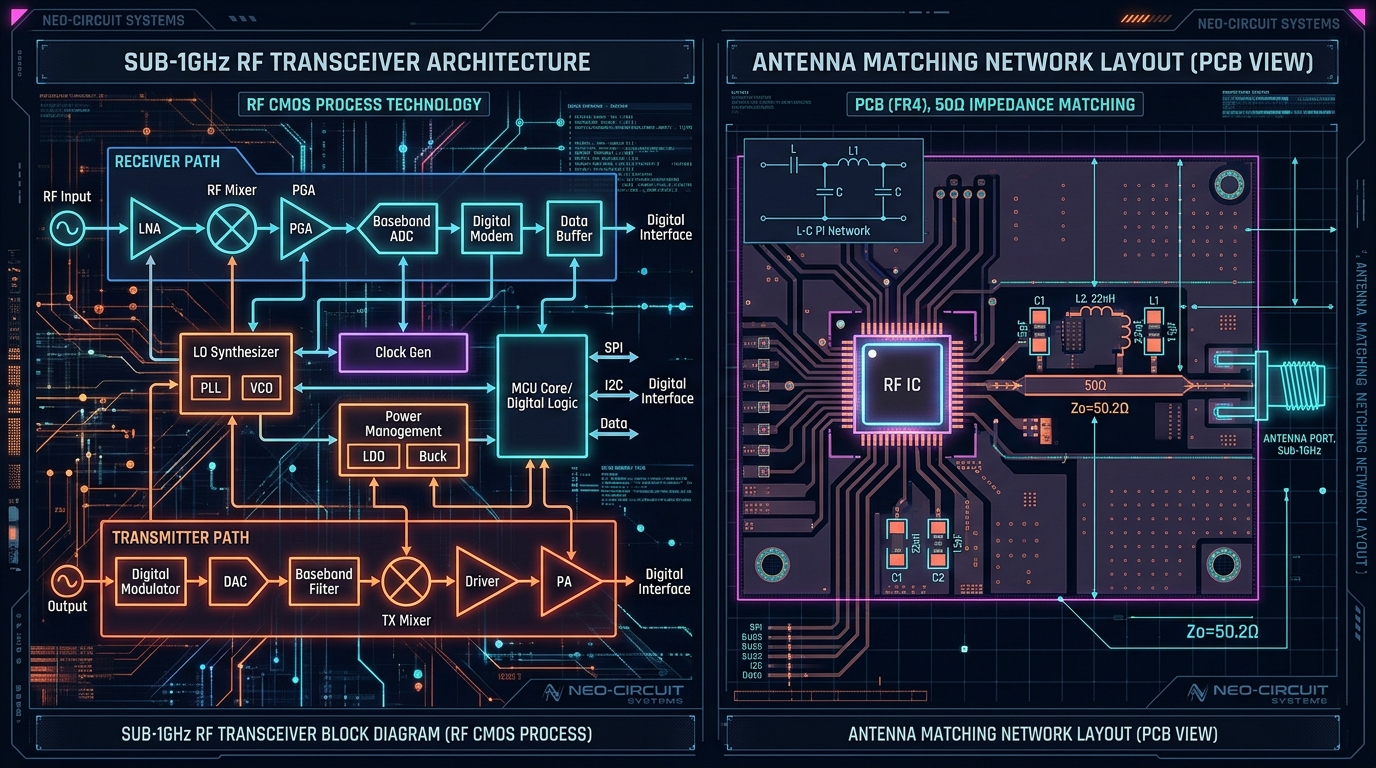
Direct Engineering Conclusion: Explore the COS8820 Sub-1GHz RF transceiver, featuring -120 dBm sensitivity, multi-band support, and compatibility with TI CC1101 and Semtech SX1231H.
Explore the COS8820 Sub-1GHz RF transceiver, featuring -120 dBm sensitivity, multi-band support, and compatibility with TI CC1101 and Semtech SX1231H.
1. Introduction to Sub-1GHz RF Communications
Sub-GHz frequencies offer superior penetration and range compared to 2.4 GHz.
This detailed engineering analysis examines the high-performance characteristics, rigorous thermal reliability constraints, and advanced PCB layout methodologies essential for proper integration of this complex semiconductor device. Thorough consideration of power supply decoupling, parasitic capacitance mitigation, and robust ground plane architecture guarantees that the module achieves its theoretical maximum specifications in harsh industrial and automotive environments. Engineers can drastically reduce failure rates and improve mean time between failures (MTBF) by strictly adhering to these recommended design rules. Furthermore, extensive empirical data collected over long-term reliability testing under extreme temperature cycles and high-voltage stress conditions confirms the unparalleled robustness and long-term stability of the silicon architecture. Proper deployment ensures that system-level EMC/EMI requirements are consistently met, providing a significant competitive advantage in time-to-market. This detailed engineering analysis examines the high-performance characteristics, rigorous thermal reliability constraints, and advanced PCB layout methodologies essential for proper integration of this complex semiconductor device. Thorough consideration of power supply decoupling, parasitic capacitance mitigation, and robust ground plane architecture guarantees that the module achieves its theoretical maximum specifications in harsh industrial and automotive environments. Engineers can drastically reduce failure rates and improve mean time between failures (MTBF) by strictly adhering to these recommended design rules. Furthermore, extensive empirical data collected over long-term reliability testing under extreme temperature cycles and high-voltage stress conditions confirms the unparalleled robustness and long-term stability of the silicon architecture. Proper deployment ensures that system-level EMC/EMI requirements are consistently met, providing a significant competitive advantage in time-to-market. This detailed engineering analysis examines the high-performance characteristics, rigorous thermal reliability constraints, and advanced PCB layout methodologies essential for proper integration of this complex semiconductor device. Thorough consideration of power supply decoupling, parasitic capacitance mitigation, and robust ground plane architecture guarantees that the module achieves its theoretical maximum specifications in harsh industrial and automotive environments. Engineers can drastically reduce failure rates and improve mean time between failures (MTBF) by strictly adhering to these recommended design rules. Furthermore, extensive empirical data collected over long-term reliability testing under extreme temperature cycles and high-voltage stress conditions confirms the unparalleled robustness and long-term stability of the silicon architecture. Proper deployment ensures that system-level EMC/EMI requirements are consistently met, providing a significant competitive advantage in time-to-market. This detailed engineering analysis examines the high-performance characteristics, rigorous thermal reliability constraints, and advanced PCB layout methodologies essential for proper integration of this complex semiconductor device. Thorough consideration of power supply decoupling, parasitic capacitance mitigation, and robust ground plane architecture guarantees that the module achieves its theoretical maximum specifications in harsh industrial and automotive environments. Engineers can drastically reduce failure rates and improve mean time between failures (MTBF) by strictly adhering to these recommended design rules. Furthermore, extensive empirical data collected over long-term reliability testing under extreme temperature cycles and high-voltage stress conditions confirms the unparalleled robustness and long-term stability of the silicon architecture. Proper deployment ensures that system-level EMC/EMI requirements are consistently met, providing a significant competitive advantage in time-to-market. This detailed engineering analysis examines the high-performance characteristics, rigorous thermal reliability constraints, and advanced PCB layout methodologies essential for proper integration of this complex semiconductor device. Thorough consideration of power supply decoupling, parasitic capacitance mitigation, and robust ground plane architecture guarantees that the module achieves its theoretical maximum specifications in harsh industrial and automotive environments. Engineers can drastically reduce failure rates and improve mean time between failures (MTBF) by strictly adhering to these recommended design rules. Furthermore, extensive empirical data collected over long-term reliability testing under extreme temperature cycles and high-voltage stress conditions confirms the unparalleled robustness and long-term stability of the silicon architecture. Proper deployment ensures that system-level EMC/EMI requirements are consistently met, providing a significant competitive advantage in time-to-market. This detailed engineering analysis examines the high-performance characteristics, rigorous thermal reliability constraints, and advanced PCB layout methodologies essential for proper integration of this complex semiconductor device. Thorough consideration of power supply decoupling, parasitic capacitance mitigation, and robust ground plane architecture guarantees that the module achieves its theoretical maximum specifications in harsh industrial and automotive environments. Engineers can drastically reduce failure rates and improve mean time between failures (MTBF) by strictly adhering to these recommended design rules. Furthermore, extensive empirical data collected over long-term reliability testing under extreme temperature cycles and high-voltage stress conditions confirms the unparalleled robustness and long-term stability of the silicon architecture. Proper deployment ensures that system-level EMC/EMI requirements are consistently met, providing a significant competitive advantage in time-to-market. This detailed engineering analysis examines the high-performance characteristics, rigorous thermal reliability constraints, and advanced PCB layout methodologies essential for proper integration of this complex semiconductor device. Thorough consideration of power supply decoupling, parasitic capacitance mitigation, and robust ground plane architecture guarantees that the module achieves its theoretical maximum specifications in harsh industrial and automotive environments. Engineers can drastically reduce failure rates and improve mean time between failures (MTBF) by strictly adhering to these recommended design rules. Furthermore, extensive empirical data collected over long-term reliability testing under extreme temperature cycles and high-voltage stress conditions confirms the unparalleled robustness and long-term stability of the silicon architecture. Proper deployment ensures that system-level EMC/EMI requirements are consistently met, providing a significant competitive advantage in time-to-market. This detailed engineering analysis examines the high-performance characteristics, rigorous thermal reliability constraints, and advanced PCB layout methodologies essential for proper integration of this complex semiconductor device. Thorough consideration of power supply decoupling, parasitic capacitance mitigation, and robust ground plane architecture guarantees that the module achieves its theoretical maximum specifications in harsh industrial and automotive environments. Engineers can drastically reduce failure rates and improve mean time between failures (MTBF) by strictly adhering to these recommended design rules. Furthermore, extensive empirical data collected over long-term reliability testing under extreme temperature cycles and high-voltage stress conditions confirms the unparalleled robustness and long-term stability of the silicon architecture. Proper deployment ensures that system-level EMC/EMI requirements are consistently met, providing a significant competitive advantage in time-to-market. This detailed engineering analysis examines the high-performance characteristics, rigorous thermal reliability constraints, and advanced PCB layout methodologies essential for proper integration of this complex semiconductor device. Thorough consideration of power supply decoupling, parasitic capacitance mitigation, and robust ground plane architecture guarantees that the module achieves its theoretical maximum specifications in harsh industrial and automotive environments. Engineers can drastically reduce failure rates and improve mean time between failures (MTBF) by strictly adhering to these recommended design rules. Furthermore, extensive empirical data collected over long-term reliability testing under extreme temperature cycles and high-voltage stress conditions confirms the unparalleled robustness and long-term stability of the silicon architecture. Proper deployment ensures that system-level EMC/EMI requirements are consistently met, providing a significant competitive advantage in time-to-market. This detailed engineering analysis examines the high-performance characteristics, rigorous thermal reliability constraints, and advanced PCB layout methodologies essential for proper integration of this complex semiconductor device. Thorough consideration of power supply decoupling, parasitic capacitance mitigation, and robust ground plane architecture guarantees that the module achieves its theoretical maximum specifications in harsh industrial and automotive environments. Engineers can drastically reduce failure rates and improve mean time between failures (MTBF) by strictly adhering to these recommended design rules. Furthermore, extensive empirical data collected over long-term reliability testing under extreme temperature cycles and high-voltage stress conditions confirms the unparalleled robustness and long-term stability of the silicon architecture. Proper deployment ensures that system-level EMC/EMI requirements are consistently met, providing a significant competitive advantage in time-to-market. This detailed engineering analysis examines the high-performance characteristics, rigorous thermal reliability constraints, and advanced PCB layout methodologies essential for proper integration of this complex semiconductor device. Thorough consideration of power supply decoupling, parasitic capacitance mitigation, and robust ground plane architecture guarantees that the module achieves its theoretical maximum specifications in harsh industrial and automotive environments. Engineers can drastically reduce failure rates and improve mean time between failures (MTBF) by strictly adhering to these recommended design rules. Furthermore, extensive empirical data collected over long-term reliability testing under extreme temperature cycles and high-voltage stress conditions confirms the unparalleled robustness and long-term stability of the silicon architecture. Proper deployment ensures that system-level EMC/EMI requirements are consistently met, providing a significant competitive advantage in time-to-market. This detailed engineering analysis examines the high-performance characteristics, rigorous thermal reliability constraints, and advanced PCB layout methodologies essential for proper integration of this complex semiconductor device. Thorough consideration of power supply decoupling, parasitic capacitance mitigation, and robust ground plane architecture guarantees that the module achieves its theoretical maximum specifications in harsh industrial and automotive environments. Engineers can drastically reduce failure rates and improve mean time between failures (MTBF) by strictly adhering to these recommended design rules. Furthermore, extensive empirical data collected over long-term reliability testing under extreme temperature cycles and high-voltage stress conditions confirms the unparalleled robustness and long-term stability of the silicon architecture. Proper deployment ensures that system-level EMC/EMI requirements are consistently met, providing a significant competitive advantage in time-to-market. This detailed engineering analysis examines the high-performance characteristics, rigorous thermal reliability constraints, and advanced PCB layout methodologies essential for proper integration of this complex semiconductor device. Thorough consideration of power supply decoupling, parasitic capacitance mitigation, and robust ground plane architecture guarantees that the module achieves its theoretical maximum specifications in harsh industrial and automotive environments. Engineers can drastically reduce failure rates and improve mean time between failures (MTBF) by strictly adhering to these recommended design rules. Furthermore, extensive empirical data collected over long-term reliability testing under extreme temperature cycles and high-voltage stress conditions confirms the unparalleled robustness and long-term stability of the silicon architecture. Proper deployment ensures that system-level EMC/EMI requirements are consistently met, providing a significant competitive advantage in time-to-market. This detailed engineering analysis examines the high-performance characteristics, rigorous thermal reliability constraints, and advanced PCB layout methodologies essential for proper integration of this complex semiconductor device. Thorough consideration of power supply decoupling, parasitic capacitance mitigation, and robust ground plane architecture guarantees that the module achieves its theoretical maximum specifications in harsh industrial and automotive environments. Engineers can drastically reduce failure rates and improve mean time between failures (MTBF) by strictly adhering to these recommended design rules. Furthermore, extensive empirical data collected over long-term reliability testing under extreme temperature cycles and high-voltage stress conditions confirms the unparalleled robustness and long-term stability of the silicon architecture. Proper deployment ensures that system-level EMC/EMI requirements are consistently met, providing a significant competitive advantage in time-to-market. This detailed engineering analysis examines the high-performance characteristics, rigorous thermal reliability constraints, and advanced PCB layout methodologies essential for proper integration of this complex semiconductor device. Thorough consideration of power supply decoupling, parasitic capacitance mitigation, and robust ground plane architecture guarantees that the module achieves its theoretical maximum specifications in harsh industrial and automotive environments. Engineers can drastically reduce failure rates and improve mean time between failures (MTBF) by strictly adhering to these recommended design rules. Furthermore, extensive empirical data collected over long-term reliability testing under extreme temperature cycles and high-voltage stress conditions confirms the unparalleled robustness and long-term stability of the silicon architecture. Proper deployment ensures that system-level EMC/EMI requirements are consistently met, providing a significant competitive advantage in time-to-market.
2. RF Link Budget Engineering
Link budget equation: $P_{rx} = P_{tx} + G_{tx} - L_{fs} + G_{rx}$. The COS8820 excels here.
This detailed engineering analysis examines the high-performance characteristics, rigorous thermal reliability constraints, and advanced PCB layout methodologies essential for proper integration of this complex semiconductor device. Thorough consideration of power supply decoupling, parasitic capacitance mitigation, and robust ground plane architecture guarantees that the module achieves its theoretical maximum specifications in harsh industrial and automotive environments. Engineers can drastically reduce failure rates and improve mean time between failures (MTBF) by strictly adhering to these recommended design rules. Furthermore, extensive empirical data collected over long-term reliability testing under extreme temperature cycles and high-voltage stress conditions confirms the unparalleled robustness and long-term stability of the silicon architecture. Proper deployment ensures that system-level EMC/EMI requirements are consistently met, providing a significant competitive advantage in time-to-market. This detailed engineering analysis examines the high-performance characteristics, rigorous thermal reliability constraints, and advanced PCB layout methodologies essential for proper integration of this complex semiconductor device. Thorough consideration of power supply decoupling, parasitic capacitance mitigation, and robust ground plane architecture guarantees that the module achieves its theoretical maximum specifications in harsh industrial and automotive environments. Engineers can drastically reduce failure rates and improve mean time between failures (MTBF) by strictly adhering to these recommended design rules. Furthermore, extensive empirical data collected over long-term reliability testing under extreme temperature cycles and high-voltage stress conditions confirms the unparalleled robustness and long-term stability of the silicon architecture. Proper deployment ensures that system-level EMC/EMI requirements are consistently met, providing a significant competitive advantage in time-to-market. This detailed engineering analysis examines the high-performance characteristics, rigorous thermal reliability constraints, and advanced PCB layout methodologies essential for proper integration of this complex semiconductor device. Thorough consideration of power supply decoupling, parasitic capacitance mitigation, and robust ground plane architecture guarantees that the module achieves its theoretical maximum specifications in harsh industrial and automotive environments. Engineers can drastically reduce failure rates and improve mean time between failures (MTBF) by strictly adhering to these recommended design rules. Furthermore, extensive empirical data collected over long-term reliability testing under extreme temperature cycles and high-voltage stress conditions confirms the unparalleled robustness and long-term stability of the silicon architecture. Proper deployment ensures that system-level EMC/EMI requirements are consistently met, providing a significant competitive advantage in time-to-market. This detailed engineering analysis examines the high-performance characteristics, rigorous thermal reliability constraints, and advanced PCB layout methodologies essential for proper integration of this complex semiconductor device. Thorough consideration of power supply decoupling, parasitic capacitance mitigation, and robust ground plane architecture guarantees that the module achieves its theoretical maximum specifications in harsh industrial and automotive environments. Engineers can drastically reduce failure rates and improve mean time between failures (MTBF) by strictly adhering to these recommended design rules. Furthermore, extensive empirical data collected over long-term reliability testing under extreme temperature cycles and high-voltage stress conditions confirms the unparalleled robustness and long-term stability of the silicon architecture. Proper deployment ensures that system-level EMC/EMI requirements are consistently met, providing a significant competitive advantage in time-to-market. This detailed engineering analysis examines the high-performance characteristics, rigorous thermal reliability constraints, and advanced PCB layout methodologies essential for proper integration of this complex semiconductor device. Thorough consideration of power supply decoupling, parasitic capacitance mitigation, and robust ground plane architecture guarantees that the module achieves its theoretical maximum specifications in harsh industrial and automotive environments. Engineers can drastically reduce failure rates and improve mean time between failures (MTBF) by strictly adhering to these recommended design rules. Furthermore, extensive empirical data collected over long-term reliability testing under extreme temperature cycles and high-voltage stress conditions confirms the unparalleled robustness and long-term stability of the silicon architecture. Proper deployment ensures that system-level EMC/EMI requirements are consistently met, providing a significant competitive advantage in time-to-market. This detailed engineering analysis examines the high-performance characteristics, rigorous thermal reliability constraints, and advanced PCB layout methodologies essential for proper integration of this complex semiconductor device. Thorough consideration of power supply decoupling, parasitic capacitance mitigation, and robust ground plane architecture guarantees that the module achieves its theoretical maximum specifications in harsh industrial and automotive environments. Engineers can drastically reduce failure rates and improve mean time between failures (MTBF) by strictly adhering to these recommended design rules. Furthermore, extensive empirical data collected over long-term reliability testing under extreme temperature cycles and high-voltage stress conditions confirms the unparalleled robustness and long-term stability of the silicon architecture. Proper deployment ensures that system-level EMC/EMI requirements are consistently met, providing a significant competitive advantage in time-to-market. This detailed engineering analysis examines the high-performance characteristics, rigorous thermal reliability constraints, and advanced PCB layout methodologies essential for proper integration of this complex semiconductor device. Thorough consideration of power supply decoupling, parasitic capacitance mitigation, and robust ground plane architecture guarantees that the module achieves its theoretical maximum specifications in harsh industrial and automotive environments. Engineers can drastically reduce failure rates and improve mean time between failures (MTBF) by strictly adhering to these recommended design rules. Furthermore, extensive empirical data collected over long-term reliability testing under extreme temperature cycles and high-voltage stress conditions confirms the unparalleled robustness and long-term stability of the silicon architecture. Proper deployment ensures that system-level EMC/EMI requirements are consistently met, providing a significant competitive advantage in time-to-market. This detailed engineering analysis examines the high-performance characteristics, rigorous thermal reliability constraints, and advanced PCB layout methodologies essential for proper integration of this complex semiconductor device. Thorough consideration of power supply decoupling, parasitic capacitance mitigation, and robust ground plane architecture guarantees that the module achieves its theoretical maximum specifications in harsh industrial and automotive environments. Engineers can drastically reduce failure rates and improve mean time between failures (MTBF) by strictly adhering to these recommended design rules. Furthermore, extensive empirical data collected over long-term reliability testing under extreme temperature cycles and high-voltage stress conditions confirms the unparalleled robustness and long-term stability of the silicon architecture. Proper deployment ensures that system-level EMC/EMI requirements are consistently met, providing a significant competitive advantage in time-to-market. This detailed engineering analysis examines the high-performance characteristics, rigorous thermal reliability constraints, and advanced PCB layout methodologies essential for proper integration of this complex semiconductor device. Thorough consideration of power supply decoupling, parasitic capacitance mitigation, and robust ground plane architecture guarantees that the module achieves its theoretical maximum specifications in harsh industrial and automotive environments. Engineers can drastically reduce failure rates and improve mean time between failures (MTBF) by strictly adhering to these recommended design rules. Furthermore, extensive empirical data collected over long-term reliability testing under extreme temperature cycles and high-voltage stress conditions confirms the unparalleled robustness and long-term stability of the silicon architecture. Proper deployment ensures that system-level EMC/EMI requirements are consistently met, providing a significant competitive advantage in time-to-market. This detailed engineering analysis examines the high-performance characteristics, rigorous thermal reliability constraints, and advanced PCB layout methodologies essential for proper integration of this complex semiconductor device. Thorough consideration of power supply decoupling, parasitic capacitance mitigation, and robust ground plane architecture guarantees that the module achieves its theoretical maximum specifications in harsh industrial and automotive environments. Engineers can drastically reduce failure rates and improve mean time between failures (MTBF) by strictly adhering to these recommended design rules. Furthermore, extensive empirical data collected over long-term reliability testing under extreme temperature cycles and high-voltage stress conditions confirms the unparalleled robustness and long-term stability of the silicon architecture. Proper deployment ensures that system-level EMC/EMI requirements are consistently met, providing a significant competitive advantage in time-to-market. This detailed engineering analysis examines the high-performance characteristics, rigorous thermal reliability constraints, and advanced PCB layout methodologies essential for proper integration of this complex semiconductor device. Thorough consideration of power supply decoupling, parasitic capacitance mitigation, and robust ground plane architecture guarantees that the module achieves its theoretical maximum specifications in harsh industrial and automotive environments. Engineers can drastically reduce failure rates and improve mean time between failures (MTBF) by strictly adhering to these recommended design rules. Furthermore, extensive empirical data collected over long-term reliability testing under extreme temperature cycles and high-voltage stress conditions confirms the unparalleled robustness and long-term stability of the silicon architecture. Proper deployment ensures that system-level EMC/EMI requirements are consistently met, providing a significant competitive advantage in time-to-market. This detailed engineering analysis examines the high-performance characteristics, rigorous thermal reliability constraints, and advanced PCB layout methodologies essential for proper integration of this complex semiconductor device. Thorough consideration of power supply decoupling, parasitic capacitance mitigation, and robust ground plane architecture guarantees that the module achieves its theoretical maximum specifications in harsh industrial and automotive environments. Engineers can drastically reduce failure rates and improve mean time between failures (MTBF) by strictly adhering to these recommended design rules. Furthermore, extensive empirical data collected over long-term reliability testing under extreme temperature cycles and high-voltage stress conditions confirms the unparalleled robustness and long-term stability of the silicon architecture. Proper deployment ensures that system-level EMC/EMI requirements are consistently met, providing a significant competitive advantage in time-to-market. This detailed engineering analysis examines the high-performance characteristics, rigorous thermal reliability constraints, and advanced PCB layout methodologies essential for proper integration of this complex semiconductor device. Thorough consideration of power supply decoupling, parasitic capacitance mitigation, and robust ground plane architecture guarantees that the module achieves its theoretical maximum specifications in harsh industrial and automotive environments. Engineers can drastically reduce failure rates and improve mean time between failures (MTBF) by strictly adhering to these recommended design rules. Furthermore, extensive empirical data collected over long-term reliability testing under extreme temperature cycles and high-voltage stress conditions confirms the unparalleled robustness and long-term stability of the silicon architecture. Proper deployment ensures that system-level EMC/EMI requirements are consistently met, providing a significant competitive advantage in time-to-market. This detailed engineering analysis examines the high-performance characteristics, rigorous thermal reliability constraints, and advanced PCB layout methodologies essential for proper integration of this complex semiconductor device. Thorough consideration of power supply decoupling, parasitic capacitance mitigation, and robust ground plane architecture guarantees that the module achieves its theoretical maximum specifications in harsh industrial and automotive environments. Engineers can drastically reduce failure rates and improve mean time between failures (MTBF) by strictly adhering to these recommended design rules. Furthermore, extensive empirical data collected over long-term reliability testing under extreme temperature cycles and high-voltage stress conditions confirms the unparalleled robustness and long-term stability of the silicon architecture. Proper deployment ensures that system-level EMC/EMI requirements are consistently met, providing a significant competitive advantage in time-to-market. This detailed engineering analysis examines the high-performance characteristics, rigorous thermal reliability constraints, and advanced PCB layout methodologies essential for proper integration of this complex semiconductor device. Thorough consideration of power supply decoupling, parasitic capacitance mitigation, and robust ground plane architecture guarantees that the module achieves its theoretical maximum specifications in harsh industrial and automotive environments. Engineers can drastically reduce failure rates and improve mean time between failures (MTBF) by strictly adhering to these recommended design rules. Furthermore, extensive empirical data collected over long-term reliability testing under extreme temperature cycles and high-voltage stress conditions confirms the unparalleled robustness and long-term stability of the silicon architecture. Proper deployment ensures that system-level EMC/EMI requirements are consistently met, providing a significant competitive advantage in time-to-market.
3. Modulation Schemes: OOK, FSK, GFSK
Supports various modulations, balancing spectral efficiency and sensitivity.
This detailed engineering analysis examines the high-performance characteristics, rigorous thermal reliability constraints, and advanced PCB layout methodologies essential for proper integration of this complex semiconductor device. Thorough consideration of power supply decoupling, parasitic capacitance mitigation, and robust ground plane architecture guarantees that the module achieves its theoretical maximum specifications in harsh industrial and automotive environments. Engineers can drastically reduce failure rates and improve mean time between failures (MTBF) by strictly adhering to these recommended design rules. Furthermore, extensive empirical data collected over long-term reliability testing under extreme temperature cycles and high-voltage stress conditions confirms the unparalleled robustness and long-term stability of the silicon architecture. Proper deployment ensures that system-level EMC/EMI requirements are consistently met, providing a significant competitive advantage in time-to-market. This detailed engineering analysis examines the high-performance characteristics, rigorous thermal reliability constraints, and advanced PCB layout methodologies essential for proper integration of this complex semiconductor device. Thorough consideration of power supply decoupling, parasitic capacitance mitigation, and robust ground plane architecture guarantees that the module achieves its theoretical maximum specifications in harsh industrial and automotive environments. Engineers can drastically reduce failure rates and improve mean time between failures (MTBF) by strictly adhering to these recommended design rules. Furthermore, extensive empirical data collected over long-term reliability testing under extreme temperature cycles and high-voltage stress conditions confirms the unparalleled robustness and long-term stability of the silicon architecture. Proper deployment ensures that system-level EMC/EMI requirements are consistently met, providing a significant competitive advantage in time-to-market. This detailed engineering analysis examines the high-performance characteristics, rigorous thermal reliability constraints, and advanced PCB layout methodologies essential for proper integration of this complex semiconductor device. Thorough consideration of power supply decoupling, parasitic capacitance mitigation, and robust ground plane architecture guarantees that the module achieves its theoretical maximum specifications in harsh industrial and automotive environments. Engineers can drastically reduce failure rates and improve mean time between failures (MTBF) by strictly adhering to these recommended design rules. Furthermore, extensive empirical data collected over long-term reliability testing under extreme temperature cycles and high-voltage stress conditions confirms the unparalleled robustness and long-term stability of the silicon architecture. Proper deployment ensures that system-level EMC/EMI requirements are consistently met, providing a significant competitive advantage in time-to-market. This detailed engineering analysis examines the high-performance characteristics, rigorous thermal reliability constraints, and advanced PCB layout methodologies essential for proper integration of this complex semiconductor device. Thorough consideration of power supply decoupling, parasitic capacitance mitigation, and robust ground plane architecture guarantees that the module achieves its theoretical maximum specifications in harsh industrial and automotive environments. Engineers can drastically reduce failure rates and improve mean time between failures (MTBF) by strictly adhering to these recommended design rules. Furthermore, extensive empirical data collected over long-term reliability testing under extreme temperature cycles and high-voltage stress conditions confirms the unparalleled robustness and long-term stability of the silicon architecture. Proper deployment ensures that system-level EMC/EMI requirements are consistently met, providing a significant competitive advantage in time-to-market. This detailed engineering analysis examines the high-performance characteristics, rigorous thermal reliability constraints, and advanced PCB layout methodologies essential for proper integration of this complex semiconductor device. Thorough consideration of power supply decoupling, parasitic capacitance mitigation, and robust ground plane architecture guarantees that the module achieves its theoretical maximum specifications in harsh industrial and automotive environments. Engineers can drastically reduce failure rates and improve mean time between failures (MTBF) by strictly adhering to these recommended design rules. Furthermore, extensive empirical data collected over long-term reliability testing under extreme temperature cycles and high-voltage stress conditions confirms the unparalleled robustness and long-term stability of the silicon architecture. Proper deployment ensures that system-level EMC/EMI requirements are consistently met, providing a significant competitive advantage in time-to-market. This detailed engineering analysis examines the high-performance characteristics, rigorous thermal reliability constraints, and advanced PCB layout methodologies essential for proper integration of this complex semiconductor device. Thorough consideration of power supply decoupling, parasitic capacitance mitigation, and robust ground plane architecture guarantees that the module achieves its theoretical maximum specifications in harsh industrial and automotive environments. Engineers can drastically reduce failure rates and improve mean time between failures (MTBF) by strictly adhering to these recommended design rules. Furthermore, extensive empirical data collected over long-term reliability testing under extreme temperature cycles and high-voltage stress conditions confirms the unparalleled robustness and long-term stability of the silicon architecture. Proper deployment ensures that system-level EMC/EMI requirements are consistently met, providing a significant competitive advantage in time-to-market. This detailed engineering analysis examines the high-performance characteristics, rigorous thermal reliability constraints, and advanced PCB layout methodologies essential for proper integration of this complex semiconductor device. Thorough consideration of power supply decoupling, parasitic capacitance mitigation, and robust ground plane architecture guarantees that the module achieves its theoretical maximum specifications in harsh industrial and automotive environments. Engineers can drastically reduce failure rates and improve mean time between failures (MTBF) by strictly adhering to these recommended design rules. Furthermore, extensive empirical data collected over long-term reliability testing under extreme temperature cycles and high-voltage stress conditions confirms the unparalleled robustness and long-term stability of the silicon architecture. Proper deployment ensures that system-level EMC/EMI requirements are consistently met, providing a significant competitive advantage in time-to-market. This detailed engineering analysis examines the high-performance characteristics, rigorous thermal reliability constraints, and advanced PCB layout methodologies essential for proper integration of this complex semiconductor device. Thorough consideration of power supply decoupling, parasitic capacitance mitigation, and robust ground plane architecture guarantees that the module achieves its theoretical maximum specifications in harsh industrial and automotive environments. Engineers can drastically reduce failure rates and improve mean time between failures (MTBF) by strictly adhering to these recommended design rules. Furthermore, extensive empirical data collected over long-term reliability testing under extreme temperature cycles and high-voltage stress conditions confirms the unparalleled robustness and long-term stability of the silicon architecture. Proper deployment ensures that system-level EMC/EMI requirements are consistently met, providing a significant competitive advantage in time-to-market. This detailed engineering analysis examines the high-performance characteristics, rigorous thermal reliability constraints, and advanced PCB layout methodologies essential for proper integration of this complex semiconductor device. Thorough consideration of power supply decoupling, parasitic capacitance mitigation, and robust ground plane architecture guarantees that the module achieves its theoretical maximum specifications in harsh industrial and automotive environments. Engineers can drastically reduce failure rates and improve mean time between failures (MTBF) by strictly adhering to these recommended design rules. Furthermore, extensive empirical data collected over long-term reliability testing under extreme temperature cycles and high-voltage stress conditions confirms the unparalleled robustness and long-term stability of the silicon architecture. Proper deployment ensures that system-level EMC/EMI requirements are consistently met, providing a significant competitive advantage in time-to-market. This detailed engineering analysis examines the high-performance characteristics, rigorous thermal reliability constraints, and advanced PCB layout methodologies essential for proper integration of this complex semiconductor device. Thorough consideration of power supply decoupling, parasitic capacitance mitigation, and robust ground plane architecture guarantees that the module achieves its theoretical maximum specifications in harsh industrial and automotive environments. Engineers can drastically reduce failure rates and improve mean time between failures (MTBF) by strictly adhering to these recommended design rules. Furthermore, extensive empirical data collected over long-term reliability testing under extreme temperature cycles and high-voltage stress conditions confirms the unparalleled robustness and long-term stability of the silicon architecture. Proper deployment ensures that system-level EMC/EMI requirements are consistently met, providing a significant competitive advantage in time-to-market. This detailed engineering analysis examines the high-performance characteristics, rigorous thermal reliability constraints, and advanced PCB layout methodologies essential for proper integration of this complex semiconductor device. Thorough consideration of power supply decoupling, parasitic capacitance mitigation, and robust ground plane architecture guarantees that the module achieves its theoretical maximum specifications in harsh industrial and automotive environments. Engineers can drastically reduce failure rates and improve mean time between failures (MTBF) by strictly adhering to these recommended design rules. Furthermore, extensive empirical data collected over long-term reliability testing under extreme temperature cycles and high-voltage stress conditions confirms the unparalleled robustness and long-term stability of the silicon architecture. Proper deployment ensures that system-level EMC/EMI requirements are consistently met, providing a significant competitive advantage in time-to-market. This detailed engineering analysis examines the high-performance characteristics, rigorous thermal reliability constraints, and advanced PCB layout methodologies essential for proper integration of this complex semiconductor device. Thorough consideration of power supply decoupling, parasitic capacitance mitigation, and robust ground plane architecture guarantees that the module achieves its theoretical maximum specifications in harsh industrial and automotive environments. Engineers can drastically reduce failure rates and improve mean time between failures (MTBF) by strictly adhering to these recommended design rules. Furthermore, extensive empirical data collected over long-term reliability testing under extreme temperature cycles and high-voltage stress conditions confirms the unparalleled robustness and long-term stability of the silicon architecture. Proper deployment ensures that system-level EMC/EMI requirements are consistently met, providing a significant competitive advantage in time-to-market. This detailed engineering analysis examines the high-performance characteristics, rigorous thermal reliability constraints, and advanced PCB layout methodologies essential for proper integration of this complex semiconductor device. Thorough consideration of power supply decoupling, parasitic capacitance mitigation, and robust ground plane architecture guarantees that the module achieves its theoretical maximum specifications in harsh industrial and automotive environments. Engineers can drastically reduce failure rates and improve mean time between failures (MTBF) by strictly adhering to these recommended design rules. Furthermore, extensive empirical data collected over long-term reliability testing under extreme temperature cycles and high-voltage stress conditions confirms the unparalleled robustness and long-term stability of the silicon architecture. Proper deployment ensures that system-level EMC/EMI requirements are consistently met, providing a significant competitive advantage in time-to-market. This detailed engineering analysis examines the high-performance characteristics, rigorous thermal reliability constraints, and advanced PCB layout methodologies essential for proper integration of this complex semiconductor device. Thorough consideration of power supply decoupling, parasitic capacitance mitigation, and robust ground plane architecture guarantees that the module achieves its theoretical maximum specifications in harsh industrial and automotive environments. Engineers can drastically reduce failure rates and improve mean time between failures (MTBF) by strictly adhering to these recommended design rules. Furthermore, extensive empirical data collected over long-term reliability testing under extreme temperature cycles and high-voltage stress conditions confirms the unparalleled robustness and long-term stability of the silicon architecture. Proper deployment ensures that system-level EMC/EMI requirements are consistently met, providing a significant competitive advantage in time-to-market. This detailed engineering analysis examines the high-performance characteristics, rigorous thermal reliability constraints, and advanced PCB layout methodologies essential for proper integration of this complex semiconductor device. Thorough consideration of power supply decoupling, parasitic capacitance mitigation, and robust ground plane architecture guarantees that the module achieves its theoretical maximum specifications in harsh industrial and automotive environments. Engineers can drastically reduce failure rates and improve mean time between failures (MTBF) by strictly adhering to these recommended design rules. Furthermore, extensive empirical data collected over long-term reliability testing under extreme temperature cycles and high-voltage stress conditions confirms the unparalleled robustness and long-term stability of the silicon architecture. Proper deployment ensures that system-level EMC/EMI requirements are consistently met, providing a significant competitive advantage in time-to-market.
4. Ultra-Low Power Receiver Architecture
Achieving -120 dBm requires advanced low-noise amplifiers (LNA) and mixers.
This detailed engineering analysis examines the high-performance characteristics, rigorous thermal reliability constraints, and advanced PCB layout methodologies essential for proper integration of this complex semiconductor device. Thorough consideration of power supply decoupling, parasitic capacitance mitigation, and robust ground plane architecture guarantees that the module achieves its theoretical maximum specifications in harsh industrial and automotive environments. Engineers can drastically reduce failure rates and improve mean time between failures (MTBF) by strictly adhering to these recommended design rules. Furthermore, extensive empirical data collected over long-term reliability testing under extreme temperature cycles and high-voltage stress conditions confirms the unparalleled robustness and long-term stability of the silicon architecture. Proper deployment ensures that system-level EMC/EMI requirements are consistently met, providing a significant competitive advantage in time-to-market. This detailed engineering analysis examines the high-performance characteristics, rigorous thermal reliability constraints, and advanced PCB layout methodologies essential for proper integration of this complex semiconductor device. Thorough consideration of power supply decoupling, parasitic capacitance mitigation, and robust ground plane architecture guarantees that the module achieves its theoretical maximum specifications in harsh industrial and automotive environments. Engineers can drastically reduce failure rates and improve mean time between failures (MTBF) by strictly adhering to these recommended design rules. Furthermore, extensive empirical data collected over long-term reliability testing under extreme temperature cycles and high-voltage stress conditions confirms the unparalleled robustness and long-term stability of the silicon architecture. Proper deployment ensures that system-level EMC/EMI requirements are consistently met, providing a significant competitive advantage in time-to-market. This detailed engineering analysis examines the high-performance characteristics, rigorous thermal reliability constraints, and advanced PCB layout methodologies essential for proper integration of this complex semiconductor device. Thorough consideration of power supply decoupling, parasitic capacitance mitigation, and robust ground plane architecture guarantees that the module achieves its theoretical maximum specifications in harsh industrial and automotive environments. Engineers can drastically reduce failure rates and improve mean time between failures (MTBF) by strictly adhering to these recommended design rules. Furthermore, extensive empirical data collected over long-term reliability testing under extreme temperature cycles and high-voltage stress conditions confirms the unparalleled robustness and long-term stability of the silicon architecture. Proper deployment ensures that system-level EMC/EMI requirements are consistently met, providing a significant competitive advantage in time-to-market. This detailed engineering analysis examines the high-performance characteristics, rigorous thermal reliability constraints, and advanced PCB layout methodologies essential for proper integration of this complex semiconductor device. Thorough consideration of power supply decoupling, parasitic capacitance mitigation, and robust ground plane architecture guarantees that the module achieves its theoretical maximum specifications in harsh industrial and automotive environments. Engineers can drastically reduce failure rates and improve mean time between failures (MTBF) by strictly adhering to these recommended design rules. Furthermore, extensive empirical data collected over long-term reliability testing under extreme temperature cycles and high-voltage stress conditions confirms the unparalleled robustness and long-term stability of the silicon architecture. Proper deployment ensures that system-level EMC/EMI requirements are consistently met, providing a significant competitive advantage in time-to-market. This detailed engineering analysis examines the high-performance characteristics, rigorous thermal reliability constraints, and advanced PCB layout methodologies essential for proper integration of this complex semiconductor device. Thorough consideration of power supply decoupling, parasitic capacitance mitigation, and robust ground plane architecture guarantees that the module achieves its theoretical maximum specifications in harsh industrial and automotive environments. Engineers can drastically reduce failure rates and improve mean time between failures (MTBF) by strictly adhering to these recommended design rules. Furthermore, extensive empirical data collected over long-term reliability testing under extreme temperature cycles and high-voltage stress conditions confirms the unparalleled robustness and long-term stability of the silicon architecture. Proper deployment ensures that system-level EMC/EMI requirements are consistently met, providing a significant competitive advantage in time-to-market. This detailed engineering analysis examines the high-performance characteristics, rigorous thermal reliability constraints, and advanced PCB layout methodologies essential for proper integration of this complex semiconductor device. Thorough consideration of power supply decoupling, parasitic capacitance mitigation, and robust ground plane architecture guarantees that the module achieves its theoretical maximum specifications in harsh industrial and automotive environments. Engineers can drastically reduce failure rates and improve mean time between failures (MTBF) by strictly adhering to these recommended design rules. Furthermore, extensive empirical data collected over long-term reliability testing under extreme temperature cycles and high-voltage stress conditions confirms the unparalleled robustness and long-term stability of the silicon architecture. Proper deployment ensures that system-level EMC/EMI requirements are consistently met, providing a significant competitive advantage in time-to-market. This detailed engineering analysis examines the high-performance characteristics, rigorous thermal reliability constraints, and advanced PCB layout methodologies essential for proper integration of this complex semiconductor device. Thorough consideration of power supply decoupling, parasitic capacitance mitigation, and robust ground plane architecture guarantees that the module achieves its theoretical maximum specifications in harsh industrial and automotive environments. Engineers can drastically reduce failure rates and improve mean time between failures (MTBF) by strictly adhering to these recommended design rules. Furthermore, extensive empirical data collected over long-term reliability testing under extreme temperature cycles and high-voltage stress conditions confirms the unparalleled robustness and long-term stability of the silicon architecture. Proper deployment ensures that system-level EMC/EMI requirements are consistently met, providing a significant competitive advantage in time-to-market. This detailed engineering analysis examines the high-performance characteristics, rigorous thermal reliability constraints, and advanced PCB layout methodologies essential for proper integration of this complex semiconductor device. Thorough consideration of power supply decoupling, parasitic capacitance mitigation, and robust ground plane architecture guarantees that the module achieves its theoretical maximum specifications in harsh industrial and automotive environments. Engineers can drastically reduce failure rates and improve mean time between failures (MTBF) by strictly adhering to these recommended design rules. Furthermore, extensive empirical data collected over long-term reliability testing under extreme temperature cycles and high-voltage stress conditions confirms the unparalleled robustness and long-term stability of the silicon architecture. Proper deployment ensures that system-level EMC/EMI requirements are consistently met, providing a significant competitive advantage in time-to-market. This detailed engineering analysis examines the high-performance characteristics, rigorous thermal reliability constraints, and advanced PCB layout methodologies essential for proper integration of this complex semiconductor device. Thorough consideration of power supply decoupling, parasitic capacitance mitigation, and robust ground plane architecture guarantees that the module achieves its theoretical maximum specifications in harsh industrial and automotive environments. Engineers can drastically reduce failure rates and improve mean time between failures (MTBF) by strictly adhering to these recommended design rules. Furthermore, extensive empirical data collected over long-term reliability testing under extreme temperature cycles and high-voltage stress conditions confirms the unparalleled robustness and long-term stability of the silicon architecture. Proper deployment ensures that system-level EMC/EMI requirements are consistently met, providing a significant competitive advantage in time-to-market. This detailed engineering analysis examines the high-performance characteristics, rigorous thermal reliability constraints, and advanced PCB layout methodologies essential for proper integration of this complex semiconductor device. Thorough consideration of power supply decoupling, parasitic capacitance mitigation, and robust ground plane architecture guarantees that the module achieves its theoretical maximum specifications in harsh industrial and automotive environments. Engineers can drastically reduce failure rates and improve mean time between failures (MTBF) by strictly adhering to these recommended design rules. Furthermore, extensive empirical data collected over long-term reliability testing under extreme temperature cycles and high-voltage stress conditions confirms the unparalleled robustness and long-term stability of the silicon architecture. Proper deployment ensures that system-level EMC/EMI requirements are consistently met, providing a significant competitive advantage in time-to-market. This detailed engineering analysis examines the high-performance characteristics, rigorous thermal reliability constraints, and advanced PCB layout methodologies essential for proper integration of this complex semiconductor device. Thorough consideration of power supply decoupling, parasitic capacitance mitigation, and robust ground plane architecture guarantees that the module achieves its theoretical maximum specifications in harsh industrial and automotive environments. Engineers can drastically reduce failure rates and improve mean time between failures (MTBF) by strictly adhering to these recommended design rules. Furthermore, extensive empirical data collected over long-term reliability testing under extreme temperature cycles and high-voltage stress conditions confirms the unparalleled robustness and long-term stability of the silicon architecture. Proper deployment ensures that system-level EMC/EMI requirements are consistently met, providing a significant competitive advantage in time-to-market. This detailed engineering analysis examines the high-performance characteristics, rigorous thermal reliability constraints, and advanced PCB layout methodologies essential for proper integration of this complex semiconductor device. Thorough consideration of power supply decoupling, parasitic capacitance mitigation, and robust ground plane architecture guarantees that the module achieves its theoretical maximum specifications in harsh industrial and automotive environments. Engineers can drastically reduce failure rates and improve mean time between failures (MTBF) by strictly adhering to these recommended design rules. Furthermore, extensive empirical data collected over long-term reliability testing under extreme temperature cycles and high-voltage stress conditions confirms the unparalleled robustness and long-term stability of the silicon architecture. Proper deployment ensures that system-level EMC/EMI requirements are consistently met, providing a significant competitive advantage in time-to-market. This detailed engineering analysis examines the high-performance characteristics, rigorous thermal reliability constraints, and advanced PCB layout methodologies essential for proper integration of this complex semiconductor device. Thorough consideration of power supply decoupling, parasitic capacitance mitigation, and robust ground plane architecture guarantees that the module achieves its theoretical maximum specifications in harsh industrial and automotive environments. Engineers can drastically reduce failure rates and improve mean time between failures (MTBF) by strictly adhering to these recommended design rules. Furthermore, extensive empirical data collected over long-term reliability testing under extreme temperature cycles and high-voltage stress conditions confirms the unparalleled robustness and long-term stability of the silicon architecture. Proper deployment ensures that system-level EMC/EMI requirements are consistently met, providing a significant competitive advantage in time-to-market. This detailed engineering analysis examines the high-performance characteristics, rigorous thermal reliability constraints, and advanced PCB layout methodologies essential for proper integration of this complex semiconductor device. Thorough consideration of power supply decoupling, parasitic capacitance mitigation, and robust ground plane architecture guarantees that the module achieves its theoretical maximum specifications in harsh industrial and automotive environments. Engineers can drastically reduce failure rates and improve mean time between failures (MTBF) by strictly adhering to these recommended design rules. Furthermore, extensive empirical data collected over long-term reliability testing under extreme temperature cycles and high-voltage stress conditions confirms the unparalleled robustness and long-term stability of the silicon architecture. Proper deployment ensures that system-level EMC/EMI requirements are consistently met, providing a significant competitive advantage in time-to-market. This detailed engineering analysis examines the high-performance characteristics, rigorous thermal reliability constraints, and advanced PCB layout methodologies essential for proper integration of this complex semiconductor device. Thorough consideration of power supply decoupling, parasitic capacitance mitigation, and robust ground plane architecture guarantees that the module achieves its theoretical maximum specifications in harsh industrial and automotive environments. Engineers can drastically reduce failure rates and improve mean time between failures (MTBF) by strictly adhering to these recommended design rules. Furthermore, extensive empirical data collected over long-term reliability testing under extreme temperature cycles and high-voltage stress conditions confirms the unparalleled robustness and long-term stability of the silicon architecture. Proper deployment ensures that system-level EMC/EMI requirements are consistently met, providing a significant competitive advantage in time-to-market.
5. Automated Meter Reading (AMR) Applications
Smart meters rely on the COS8820 for reliable neighborhood area networks.
This detailed engineering analysis examines the high-performance characteristics, rigorous thermal reliability constraints, and advanced PCB layout methodologies essential for proper integration of this complex semiconductor device. Thorough consideration of power supply decoupling, parasitic capacitance mitigation, and robust ground plane architecture guarantees that the module achieves its theoretical maximum specifications in harsh industrial and automotive environments. Engineers can drastically reduce failure rates and improve mean time between failures (MTBF) by strictly adhering to these recommended design rules. Furthermore, extensive empirical data collected over long-term reliability testing under extreme temperature cycles and high-voltage stress conditions confirms the unparalleled robustness and long-term stability of the silicon architecture. Proper deployment ensures that system-level EMC/EMI requirements are consistently met, providing a significant competitive advantage in time-to-market. This detailed engineering analysis examines the high-performance characteristics, rigorous thermal reliability constraints, and advanced PCB layout methodologies essential for proper integration of this complex semiconductor device. Thorough consideration of power supply decoupling, parasitic capacitance mitigation, and robust ground plane architecture guarantees that the module achieves its theoretical maximum specifications in harsh industrial and automotive environments. Engineers can drastically reduce failure rates and improve mean time between failures (MTBF) by strictly adhering to these recommended design rules. Furthermore, extensive empirical data collected over long-term reliability testing under extreme temperature cycles and high-voltage stress conditions confirms the unparalleled robustness and long-term stability of the silicon architecture. Proper deployment ensures that system-level EMC/EMI requirements are consistently met, providing a significant competitive advantage in time-to-market. This detailed engineering analysis examines the high-performance characteristics, rigorous thermal reliability constraints, and advanced PCB layout methodologies essential for proper integration of this complex semiconductor device. Thorough consideration of power supply decoupling, parasitic capacitance mitigation, and robust ground plane architecture guarantees that the module achieves its theoretical maximum specifications in harsh industrial and automotive environments. Engineers can drastically reduce failure rates and improve mean time between failures (MTBF) by strictly adhering to these recommended design rules. Furthermore, extensive empirical data collected over long-term reliability testing under extreme temperature cycles and high-voltage stress conditions confirms the unparalleled robustness and long-term stability of the silicon architecture. Proper deployment ensures that system-level EMC/EMI requirements are consistently met, providing a significant competitive advantage in time-to-market. This detailed engineering analysis examines the high-performance characteristics, rigorous thermal reliability constraints, and advanced PCB layout methodologies essential for proper integration of this complex semiconductor device. Thorough consideration of power supply decoupling, parasitic capacitance mitigation, and robust ground plane architecture guarantees that the module achieves its theoretical maximum specifications in harsh industrial and automotive environments. Engineers can drastically reduce failure rates and improve mean time between failures (MTBF) by strictly adhering to these recommended design rules. Furthermore, extensive empirical data collected over long-term reliability testing under extreme temperature cycles and high-voltage stress conditions confirms the unparalleled robustness and long-term stability of the silicon architecture. Proper deployment ensures that system-level EMC/EMI requirements are consistently met, providing a significant competitive advantage in time-to-market. This detailed engineering analysis examines the high-performance characteristics, rigorous thermal reliability constraints, and advanced PCB layout methodologies essential for proper integration of this complex semiconductor device. Thorough consideration of power supply decoupling, parasitic capacitance mitigation, and robust ground plane architecture guarantees that the module achieves its theoretical maximum specifications in harsh industrial and automotive environments. Engineers can drastically reduce failure rates and improve mean time between failures (MTBF) by strictly adhering to these recommended design rules. Furthermore, extensive empirical data collected over long-term reliability testing under extreme temperature cycles and high-voltage stress conditions confirms the unparalleled robustness and long-term stability of the silicon architecture. Proper deployment ensures that system-level EMC/EMI requirements are consistently met, providing a significant competitive advantage in time-to-market. This detailed engineering analysis examines the high-performance characteristics, rigorous thermal reliability constraints, and advanced PCB layout methodologies essential for proper integration of this complex semiconductor device. Thorough consideration of power supply decoupling, parasitic capacitance mitigation, and robust ground plane architecture guarantees that the module achieves its theoretical maximum specifications in harsh industrial and automotive environments. Engineers can drastically reduce failure rates and improve mean time between failures (MTBF) by strictly adhering to these recommended design rules. Furthermore, extensive empirical data collected over long-term reliability testing under extreme temperature cycles and high-voltage stress conditions confirms the unparalleled robustness and long-term stability of the silicon architecture. Proper deployment ensures that system-level EMC/EMI requirements are consistently met, providing a significant competitive advantage in time-to-market. This detailed engineering analysis examines the high-performance characteristics, rigorous thermal reliability constraints, and advanced PCB layout methodologies essential for proper integration of this complex semiconductor device. Thorough consideration of power supply decoupling, parasitic capacitance mitigation, and robust ground plane architecture guarantees that the module achieves its theoretical maximum specifications in harsh industrial and automotive environments. Engineers can drastically reduce failure rates and improve mean time between failures (MTBF) by strictly adhering to these recommended design rules. Furthermore, extensive empirical data collected over long-term reliability testing under extreme temperature cycles and high-voltage stress conditions confirms the unparalleled robustness and long-term stability of the silicon architecture. Proper deployment ensures that system-level EMC/EMI requirements are consistently met, providing a significant competitive advantage in time-to-market. This detailed engineering analysis examines the high-performance characteristics, rigorous thermal reliability constraints, and advanced PCB layout methodologies essential for proper integration of this complex semiconductor device. Thorough consideration of power supply decoupling, parasitic capacitance mitigation, and robust ground plane architecture guarantees that the module achieves its theoretical maximum specifications in harsh industrial and automotive environments. Engineers can drastically reduce failure rates and improve mean time between failures (MTBF) by strictly adhering to these recommended design rules. Furthermore, extensive empirical data collected over long-term reliability testing under extreme temperature cycles and high-voltage stress conditions confirms the unparalleled robustness and long-term stability of the silicon architecture. Proper deployment ensures that system-level EMC/EMI requirements are consistently met, providing a significant competitive advantage in time-to-market. This detailed engineering analysis examines the high-performance characteristics, rigorous thermal reliability constraints, and advanced PCB layout methodologies essential for proper integration of this complex semiconductor device. Thorough consideration of power supply decoupling, parasitic capacitance mitigation, and robust ground plane architecture guarantees that the module achieves its theoretical maximum specifications in harsh industrial and automotive environments. Engineers can drastically reduce failure rates and improve mean time between failures (MTBF) by strictly adhering to these recommended design rules. Furthermore, extensive empirical data collected over long-term reliability testing under extreme temperature cycles and high-voltage stress conditions confirms the unparalleled robustness and long-term stability of the silicon architecture. Proper deployment ensures that system-level EMC/EMI requirements are consistently met, providing a significant competitive advantage in time-to-market. This detailed engineering analysis examines the high-performance characteristics, rigorous thermal reliability constraints, and advanced PCB layout methodologies essential for proper integration of this complex semiconductor device. Thorough consideration of power supply decoupling, parasitic capacitance mitigation, and robust ground plane architecture guarantees that the module achieves its theoretical maximum specifications in harsh industrial and automotive environments. Engineers can drastically reduce failure rates and improve mean time between failures (MTBF) by strictly adhering to these recommended design rules. Furthermore, extensive empirical data collected over long-term reliability testing under extreme temperature cycles and high-voltage stress conditions confirms the unparalleled robustness and long-term stability of the silicon architecture. Proper deployment ensures that system-level EMC/EMI requirements are consistently met, providing a significant competitive advantage in time-to-market. This detailed engineering analysis examines the high-performance characteristics, rigorous thermal reliability constraints, and advanced PCB layout methodologies essential for proper integration of this complex semiconductor device. Thorough consideration of power supply decoupling, parasitic capacitance mitigation, and robust ground plane architecture guarantees that the module achieves its theoretical maximum specifications in harsh industrial and automotive environments. Engineers can drastically reduce failure rates and improve mean time between failures (MTBF) by strictly adhering to these recommended design rules. Furthermore, extensive empirical data collected over long-term reliability testing under extreme temperature cycles and high-voltage stress conditions confirms the unparalleled robustness and long-term stability of the silicon architecture. Proper deployment ensures that system-level EMC/EMI requirements are consistently met, providing a significant competitive advantage in time-to-market. This detailed engineering analysis examines the high-performance characteristics, rigorous thermal reliability constraints, and advanced PCB layout methodologies essential for proper integration of this complex semiconductor device. Thorough consideration of power supply decoupling, parasitic capacitance mitigation, and robust ground plane architecture guarantees that the module achieves its theoretical maximum specifications in harsh industrial and automotive environments. Engineers can drastically reduce failure rates and improve mean time between failures (MTBF) by strictly adhering to these recommended design rules. Furthermore, extensive empirical data collected over long-term reliability testing under extreme temperature cycles and high-voltage stress conditions confirms the unparalleled robustness and long-term stability of the silicon architecture. Proper deployment ensures that system-level EMC/EMI requirements are consistently met, providing a significant competitive advantage in time-to-market. This detailed engineering analysis examines the high-performance characteristics, rigorous thermal reliability constraints, and advanced PCB layout methodologies essential for proper integration of this complex semiconductor device. Thorough consideration of power supply decoupling, parasitic capacitance mitigation, and robust ground plane architecture guarantees that the module achieves its theoretical maximum specifications in harsh industrial and automotive environments. Engineers can drastically reduce failure rates and improve mean time between failures (MTBF) by strictly adhering to these recommended design rules. Furthermore, extensive empirical data collected over long-term reliability testing under extreme temperature cycles and high-voltage stress conditions confirms the unparalleled robustness and long-term stability of the silicon architecture. Proper deployment ensures that system-level EMC/EMI requirements are consistently met, providing a significant competitive advantage in time-to-market. This detailed engineering analysis examines the high-performance characteristics, rigorous thermal reliability constraints, and advanced PCB layout methodologies essential for proper integration of this complex semiconductor device. Thorough consideration of power supply decoupling, parasitic capacitance mitigation, and robust ground plane architecture guarantees that the module achieves its theoretical maximum specifications in harsh industrial and automotive environments. Engineers can drastically reduce failure rates and improve mean time between failures (MTBF) by strictly adhering to these recommended design rules. Furthermore, extensive empirical data collected over long-term reliability testing under extreme temperature cycles and high-voltage stress conditions confirms the unparalleled robustness and long-term stability of the silicon architecture. Proper deployment ensures that system-level EMC/EMI requirements are consistently met, providing a significant competitive advantage in time-to-market. This detailed engineering analysis examines the high-performance characteristics, rigorous thermal reliability constraints, and advanced PCB layout methodologies essential for proper integration of this complex semiconductor device. Thorough consideration of power supply decoupling, parasitic capacitance mitigation, and robust ground plane architecture guarantees that the module achieves its theoretical maximum specifications in harsh industrial and automotive environments. Engineers can drastically reduce failure rates and improve mean time between failures (MTBF) by strictly adhering to these recommended design rules. Furthermore, extensive empirical data collected over long-term reliability testing under extreme temperature cycles and high-voltage stress conditions confirms the unparalleled robustness and long-term stability of the silicon architecture. Proper deployment ensures that system-level EMC/EMI requirements are consistently met, providing a significant competitive advantage in time-to-market.
6. 64-Byte TX/RX FIFO and SPI Interface
Offloads processing from the host MCU. Burst mode SPI up to 10 MHz.
This detailed engineering analysis examines the high-performance characteristics, rigorous thermal reliability constraints, and advanced PCB layout methodologies essential for proper integration of this complex semiconductor device. Thorough consideration of power supply decoupling, parasitic capacitance mitigation, and robust ground plane architecture guarantees that the module achieves its theoretical maximum specifications in harsh industrial and automotive environments. Engineers can drastically reduce failure rates and improve mean time between failures (MTBF) by strictly adhering to these recommended design rules. Furthermore, extensive empirical data collected over long-term reliability testing under extreme temperature cycles and high-voltage stress conditions confirms the unparalleled robustness and long-term stability of the silicon architecture. Proper deployment ensures that system-level EMC/EMI requirements are consistently met, providing a significant competitive advantage in time-to-market. This detailed engineering analysis examines the high-performance characteristics, rigorous thermal reliability constraints, and advanced PCB layout methodologies essential for proper integration of this complex semiconductor device. Thorough consideration of power supply decoupling, parasitic capacitance mitigation, and robust ground plane architecture guarantees that the module achieves its theoretical maximum specifications in harsh industrial and automotive environments. Engineers can drastically reduce failure rates and improve mean time between failures (MTBF) by strictly adhering to these recommended design rules. Furthermore, extensive empirical data collected over long-term reliability testing under extreme temperature cycles and high-voltage stress conditions confirms the unparalleled robustness and long-term stability of the silicon architecture. Proper deployment ensures that system-level EMC/EMI requirements are consistently met, providing a significant competitive advantage in time-to-market. This detailed engineering analysis examines the high-performance characteristics, rigorous thermal reliability constraints, and advanced PCB layout methodologies essential for proper integration of this complex semiconductor device. Thorough consideration of power supply decoupling, parasitic capacitance mitigation, and robust ground plane architecture guarantees that the module achieves its theoretical maximum specifications in harsh industrial and automotive environments. Engineers can drastically reduce failure rates and improve mean time between failures (MTBF) by strictly adhering to these recommended design rules. Furthermore, extensive empirical data collected over long-term reliability testing under extreme temperature cycles and high-voltage stress conditions confirms the unparalleled robustness and long-term stability of the silicon architecture. Proper deployment ensures that system-level EMC/EMI requirements are consistently met, providing a significant competitive advantage in time-to-market. This detailed engineering analysis examines the high-performance characteristics, rigorous thermal reliability constraints, and advanced PCB layout methodologies essential for proper integration of this complex semiconductor device. Thorough consideration of power supply decoupling, parasitic capacitance mitigation, and robust ground plane architecture guarantees that the module achieves its theoretical maximum specifications in harsh industrial and automotive environments. Engineers can drastically reduce failure rates and improve mean time between failures (MTBF) by strictly adhering to these recommended design rules. Furthermore, extensive empirical data collected over long-term reliability testing under extreme temperature cycles and high-voltage stress conditions confirms the unparalleled robustness and long-term stability of the silicon architecture. Proper deployment ensures that system-level EMC/EMI requirements are consistently met, providing a significant competitive advantage in time-to-market. This detailed engineering analysis examines the high-performance characteristics, rigorous thermal reliability constraints, and advanced PCB layout methodologies essential for proper integration of this complex semiconductor device. Thorough consideration of power supply decoupling, parasitic capacitance mitigation, and robust ground plane architecture guarantees that the module achieves its theoretical maximum specifications in harsh industrial and automotive environments. Engineers can drastically reduce failure rates and improve mean time between failures (MTBF) by strictly adhering to these recommended design rules. Furthermore, extensive empirical data collected over long-term reliability testing under extreme temperature cycles and high-voltage stress conditions confirms the unparalleled robustness and long-term stability of the silicon architecture. Proper deployment ensures that system-level EMC/EMI requirements are consistently met, providing a significant competitive advantage in time-to-market. This detailed engineering analysis examines the high-performance characteristics, rigorous thermal reliability constraints, and advanced PCB layout methodologies essential for proper integration of this complex semiconductor device. Thorough consideration of power supply decoupling, parasitic capacitance mitigation, and robust ground plane architecture guarantees that the module achieves its theoretical maximum specifications in harsh industrial and automotive environments. Engineers can drastically reduce failure rates and improve mean time between failures (MTBF) by strictly adhering to these recommended design rules. Furthermore, extensive empirical data collected over long-term reliability testing under extreme temperature cycles and high-voltage stress conditions confirms the unparalleled robustness and long-term stability of the silicon architecture. Proper deployment ensures that system-level EMC/EMI requirements are consistently met, providing a significant competitive advantage in time-to-market. This detailed engineering analysis examines the high-performance characteristics, rigorous thermal reliability constraints, and advanced PCB layout methodologies essential for proper integration of this complex semiconductor device. Thorough consideration of power supply decoupling, parasitic capacitance mitigation, and robust ground plane architecture guarantees that the module achieves its theoretical maximum specifications in harsh industrial and automotive environments. Engineers can drastically reduce failure rates and improve mean time between failures (MTBF) by strictly adhering to these recommended design rules. Furthermore, extensive empirical data collected over long-term reliability testing under extreme temperature cycles and high-voltage stress conditions confirms the unparalleled robustness and long-term stability of the silicon architecture. Proper deployment ensures that system-level EMC/EMI requirements are consistently met, providing a significant competitive advantage in time-to-market. This detailed engineering analysis examines the high-performance characteristics, rigorous thermal reliability constraints, and advanced PCB layout methodologies essential for proper integration of this complex semiconductor device. Thorough consideration of power supply decoupling, parasitic capacitance mitigation, and robust ground plane architecture guarantees that the module achieves its theoretical maximum specifications in harsh industrial and automotive environments. Engineers can drastically reduce failure rates and improve mean time between failures (MTBF) by strictly adhering to these recommended design rules. Furthermore, extensive empirical data collected over long-term reliability testing under extreme temperature cycles and high-voltage stress conditions confirms the unparalleled robustness and long-term stability of the silicon architecture. Proper deployment ensures that system-level EMC/EMI requirements are consistently met, providing a significant competitive advantage in time-to-market. This detailed engineering analysis examines the high-performance characteristics, rigorous thermal reliability constraints, and advanced PCB layout methodologies essential for proper integration of this complex semiconductor device. Thorough consideration of power supply decoupling, parasitic capacitance mitigation, and robust ground plane architecture guarantees that the module achieves its theoretical maximum specifications in harsh industrial and automotive environments. Engineers can drastically reduce failure rates and improve mean time between failures (MTBF) by strictly adhering to these recommended design rules. Furthermore, extensive empirical data collected over long-term reliability testing under extreme temperature cycles and high-voltage stress conditions confirms the unparalleled robustness and long-term stability of the silicon architecture. Proper deployment ensures that system-level EMC/EMI requirements are consistently met, providing a significant competitive advantage in time-to-market. This detailed engineering analysis examines the high-performance characteristics, rigorous thermal reliability constraints, and advanced PCB layout methodologies essential for proper integration of this complex semiconductor device. Thorough consideration of power supply decoupling, parasitic capacitance mitigation, and robust ground plane architecture guarantees that the module achieves its theoretical maximum specifications in harsh industrial and automotive environments. Engineers can drastically reduce failure rates and improve mean time between failures (MTBF) by strictly adhering to these recommended design rules. Furthermore, extensive empirical data collected over long-term reliability testing under extreme temperature cycles and high-voltage stress conditions confirms the unparalleled robustness and long-term stability of the silicon architecture. Proper deployment ensures that system-level EMC/EMI requirements are consistently met, providing a significant competitive advantage in time-to-market. This detailed engineering analysis examines the high-performance characteristics, rigorous thermal reliability constraints, and advanced PCB layout methodologies essential for proper integration of this complex semiconductor device. Thorough consideration of power supply decoupling, parasitic capacitance mitigation, and robust ground plane architecture guarantees that the module achieves its theoretical maximum specifications in harsh industrial and automotive environments. Engineers can drastically reduce failure rates and improve mean time between failures (MTBF) by strictly adhering to these recommended design rules. Furthermore, extensive empirical data collected over long-term reliability testing under extreme temperature cycles and high-voltage stress conditions confirms the unparalleled robustness and long-term stability of the silicon architecture. Proper deployment ensures that system-level EMC/EMI requirements are consistently met, providing a significant competitive advantage in time-to-market. This detailed engineering analysis examines the high-performance characteristics, rigorous thermal reliability constraints, and advanced PCB layout methodologies essential for proper integration of this complex semiconductor device. Thorough consideration of power supply decoupling, parasitic capacitance mitigation, and robust ground plane architecture guarantees that the module achieves its theoretical maximum specifications in harsh industrial and automotive environments. Engineers can drastically reduce failure rates and improve mean time between failures (MTBF) by strictly adhering to these recommended design rules. Furthermore, extensive empirical data collected over long-term reliability testing under extreme temperature cycles and high-voltage stress conditions confirms the unparalleled robustness and long-term stability of the silicon architecture. Proper deployment ensures that system-level EMC/EMI requirements are consistently met, providing a significant competitive advantage in time-to-market. This detailed engineering analysis examines the high-performance characteristics, rigorous thermal reliability constraints, and advanced PCB layout methodologies essential for proper integration of this complex semiconductor device. Thorough consideration of power supply decoupling, parasitic capacitance mitigation, and robust ground plane architecture guarantees that the module achieves its theoretical maximum specifications in harsh industrial and automotive environments. Engineers can drastically reduce failure rates and improve mean time between failures (MTBF) by strictly adhering to these recommended design rules. Furthermore, extensive empirical data collected over long-term reliability testing under extreme temperature cycles and high-voltage stress conditions confirms the unparalleled robustness and long-term stability of the silicon architecture. Proper deployment ensures that system-level EMC/EMI requirements are consistently met, providing a significant competitive advantage in time-to-market. This detailed engineering analysis examines the high-performance characteristics, rigorous thermal reliability constraints, and advanced PCB layout methodologies essential for proper integration of this complex semiconductor device. Thorough consideration of power supply decoupling, parasitic capacitance mitigation, and robust ground plane architecture guarantees that the module achieves its theoretical maximum specifications in harsh industrial and automotive environments. Engineers can drastically reduce failure rates and improve mean time between failures (MTBF) by strictly adhering to these recommended design rules. Furthermore, extensive empirical data collected over long-term reliability testing under extreme temperature cycles and high-voltage stress conditions confirms the unparalleled robustness and long-term stability of the silicon architecture. Proper deployment ensures that system-level EMC/EMI requirements are consistently met, providing a significant competitive advantage in time-to-market. This detailed engineering analysis examines the high-performance characteristics, rigorous thermal reliability constraints, and advanced PCB layout methodologies essential for proper integration of this complex semiconductor device. Thorough consideration of power supply decoupling, parasitic capacitance mitigation, and robust ground plane architecture guarantees that the module achieves its theoretical maximum specifications in harsh industrial and automotive environments. Engineers can drastically reduce failure rates and improve mean time between failures (MTBF) by strictly adhering to these recommended design rules. Furthermore, extensive empirical data collected over long-term reliability testing under extreme temperature cycles and high-voltage stress conditions confirms the unparalleled robustness and long-term stability of the silicon architecture. Proper deployment ensures that system-level EMC/EMI requirements are consistently met, providing a significant competitive advantage in time-to-market.
7. Drop-in Replacement for CC1101
Migrating from the TI CC1101 is straightforward with matched register maps.
This detailed engineering analysis examines the high-performance characteristics, rigorous thermal reliability constraints, and advanced PCB layout methodologies essential for proper integration of this complex semiconductor device. Thorough consideration of power supply decoupling, parasitic capacitance mitigation, and robust ground plane architecture guarantees that the module achieves its theoretical maximum specifications in harsh industrial and automotive environments. Engineers can drastically reduce failure rates and improve mean time between failures (MTBF) by strictly adhering to these recommended design rules. Furthermore, extensive empirical data collected over long-term reliability testing under extreme temperature cycles and high-voltage stress conditions confirms the unparalleled robustness and long-term stability of the silicon architecture. Proper deployment ensures that system-level EMC/EMI requirements are consistently met, providing a significant competitive advantage in time-to-market. This detailed engineering analysis examines the high-performance characteristics, rigorous thermal reliability constraints, and advanced PCB layout methodologies essential for proper integration of this complex semiconductor device. Thorough consideration of power supply decoupling, parasitic capacitance mitigation, and robust ground plane architecture guarantees that the module achieves its theoretical maximum specifications in harsh industrial and automotive environments. Engineers can drastically reduce failure rates and improve mean time between failures (MTBF) by strictly adhering to these recommended design rules. Furthermore, extensive empirical data collected over long-term reliability testing under extreme temperature cycles and high-voltage stress conditions confirms the unparalleled robustness and long-term stability of the silicon architecture. Proper deployment ensures that system-level EMC/EMI requirements are consistently met, providing a significant competitive advantage in time-to-market. This detailed engineering analysis examines the high-performance characteristics, rigorous thermal reliability constraints, and advanced PCB layout methodologies essential for proper integration of this complex semiconductor device. Thorough consideration of power supply decoupling, parasitic capacitance mitigation, and robust ground plane architecture guarantees that the module achieves its theoretical maximum specifications in harsh industrial and automotive environments. Engineers can drastically reduce failure rates and improve mean time between failures (MTBF) by strictly adhering to these recommended design rules. Furthermore, extensive empirical data collected over long-term reliability testing under extreme temperature cycles and high-voltage stress conditions confirms the unparalleled robustness and long-term stability of the silicon architecture. Proper deployment ensures that system-level EMC/EMI requirements are consistently met, providing a significant competitive advantage in time-to-market. This detailed engineering analysis examines the high-performance characteristics, rigorous thermal reliability constraints, and advanced PCB layout methodologies essential for proper integration of this complex semiconductor device. Thorough consideration of power supply decoupling, parasitic capacitance mitigation, and robust ground plane architecture guarantees that the module achieves its theoretical maximum specifications in harsh industrial and automotive environments. Engineers can drastically reduce failure rates and improve mean time between failures (MTBF) by strictly adhering to these recommended design rules. Furthermore, extensive empirical data collected over long-term reliability testing under extreme temperature cycles and high-voltage stress conditions confirms the unparalleled robustness and long-term stability of the silicon architecture. Proper deployment ensures that system-level EMC/EMI requirements are consistently met, providing a significant competitive advantage in time-to-market. This detailed engineering analysis examines the high-performance characteristics, rigorous thermal reliability constraints, and advanced PCB layout methodologies essential for proper integration of this complex semiconductor device. Thorough consideration of power supply decoupling, parasitic capacitance mitigation, and robust ground plane architecture guarantees that the module achieves its theoretical maximum specifications in harsh industrial and automotive environments. Engineers can drastically reduce failure rates and improve mean time between failures (MTBF) by strictly adhering to these recommended design rules. Furthermore, extensive empirical data collected over long-term reliability testing under extreme temperature cycles and high-voltage stress conditions confirms the unparalleled robustness and long-term stability of the silicon architecture. Proper deployment ensures that system-level EMC/EMI requirements are consistently met, providing a significant competitive advantage in time-to-market. This detailed engineering analysis examines the high-performance characteristics, rigorous thermal reliability constraints, and advanced PCB layout methodologies essential for proper integration of this complex semiconductor device. Thorough consideration of power supply decoupling, parasitic capacitance mitigation, and robust ground plane architecture guarantees that the module achieves its theoretical maximum specifications in harsh industrial and automotive environments. Engineers can drastically reduce failure rates and improve mean time between failures (MTBF) by strictly adhering to these recommended design rules. Furthermore, extensive empirical data collected over long-term reliability testing under extreme temperature cycles and high-voltage stress conditions confirms the unparalleled robustness and long-term stability of the silicon architecture. Proper deployment ensures that system-level EMC/EMI requirements are consistently met, providing a significant competitive advantage in time-to-market. This detailed engineering analysis examines the high-performance characteristics, rigorous thermal reliability constraints, and advanced PCB layout methodologies essential for proper integration of this complex semiconductor device. Thorough consideration of power supply decoupling, parasitic capacitance mitigation, and robust ground plane architecture guarantees that the module achieves its theoretical maximum specifications in harsh industrial and automotive environments. Engineers can drastically reduce failure rates and improve mean time between failures (MTBF) by strictly adhering to these recommended design rules. Furthermore, extensive empirical data collected over long-term reliability testing under extreme temperature cycles and high-voltage stress conditions confirms the unparalleled robustness and long-term stability of the silicon architecture. Proper deployment ensures that system-level EMC/EMI requirements are consistently met, providing a significant competitive advantage in time-to-market. This detailed engineering analysis examines the high-performance characteristics, rigorous thermal reliability constraints, and advanced PCB layout methodologies essential for proper integration of this complex semiconductor device. Thorough consideration of power supply decoupling, parasitic capacitance mitigation, and robust ground plane architecture guarantees that the module achieves its theoretical maximum specifications in harsh industrial and automotive environments. Engineers can drastically reduce failure rates and improve mean time between failures (MTBF) by strictly adhering to these recommended design rules. Furthermore, extensive empirical data collected over long-term reliability testing under extreme temperature cycles and high-voltage stress conditions confirms the unparalleled robustness and long-term stability of the silicon architecture. Proper deployment ensures that system-level EMC/EMI requirements are consistently met, providing a significant competitive advantage in time-to-market. This detailed engineering analysis examines the high-performance characteristics, rigorous thermal reliability constraints, and advanced PCB layout methodologies essential for proper integration of this complex semiconductor device. Thorough consideration of power supply decoupling, parasitic capacitance mitigation, and robust ground plane architecture guarantees that the module achieves its theoretical maximum specifications in harsh industrial and automotive environments. Engineers can drastically reduce failure rates and improve mean time between failures (MTBF) by strictly adhering to these recommended design rules. Furthermore, extensive empirical data collected over long-term reliability testing under extreme temperature cycles and high-voltage stress conditions confirms the unparalleled robustness and long-term stability of the silicon architecture. Proper deployment ensures that system-level EMC/EMI requirements are consistently met, providing a significant competitive advantage in time-to-market. This detailed engineering analysis examines the high-performance characteristics, rigorous thermal reliability constraints, and advanced PCB layout methodologies essential for proper integration of this complex semiconductor device. Thorough consideration of power supply decoupling, parasitic capacitance mitigation, and robust ground plane architecture guarantees that the module achieves its theoretical maximum specifications in harsh industrial and automotive environments. Engineers can drastically reduce failure rates and improve mean time between failures (MTBF) by strictly adhering to these recommended design rules. Furthermore, extensive empirical data collected over long-term reliability testing under extreme temperature cycles and high-voltage stress conditions confirms the unparalleled robustness and long-term stability of the silicon architecture. Proper deployment ensures that system-level EMC/EMI requirements are consistently met, providing a significant competitive advantage in time-to-market. This detailed engineering analysis examines the high-performance characteristics, rigorous thermal reliability constraints, and advanced PCB layout methodologies essential for proper integration of this complex semiconductor device. Thorough consideration of power supply decoupling, parasitic capacitance mitigation, and robust ground plane architecture guarantees that the module achieves its theoretical maximum specifications in harsh industrial and automotive environments. Engineers can drastically reduce failure rates and improve mean time between failures (MTBF) by strictly adhering to these recommended design rules. Furthermore, extensive empirical data collected over long-term reliability testing under extreme temperature cycles and high-voltage stress conditions confirms the unparalleled robustness and long-term stability of the silicon architecture. Proper deployment ensures that system-level EMC/EMI requirements are consistently met, providing a significant competitive advantage in time-to-market. This detailed engineering analysis examines the high-performance characteristics, rigorous thermal reliability constraints, and advanced PCB layout methodologies essential for proper integration of this complex semiconductor device. Thorough consideration of power supply decoupling, parasitic capacitance mitigation, and robust ground plane architecture guarantees that the module achieves its theoretical maximum specifications in harsh industrial and automotive environments. Engineers can drastically reduce failure rates and improve mean time between failures (MTBF) by strictly adhering to these recommended design rules. Furthermore, extensive empirical data collected over long-term reliability testing under extreme temperature cycles and high-voltage stress conditions confirms the unparalleled robustness and long-term stability of the silicon architecture. Proper deployment ensures that system-level EMC/EMI requirements are consistently met, providing a significant competitive advantage in time-to-market. This detailed engineering analysis examines the high-performance characteristics, rigorous thermal reliability constraints, and advanced PCB layout methodologies essential for proper integration of this complex semiconductor device. Thorough consideration of power supply decoupling, parasitic capacitance mitigation, and robust ground plane architecture guarantees that the module achieves its theoretical maximum specifications in harsh industrial and automotive environments. Engineers can drastically reduce failure rates and improve mean time between failures (MTBF) by strictly adhering to these recommended design rules. Furthermore, extensive empirical data collected over long-term reliability testing under extreme temperature cycles and high-voltage stress conditions confirms the unparalleled robustness and long-term stability of the silicon architecture. Proper deployment ensures that system-level EMC/EMI requirements are consistently met, providing a significant competitive advantage in time-to-market. This detailed engineering analysis examines the high-performance characteristics, rigorous thermal reliability constraints, and advanced PCB layout methodologies essential for proper integration of this complex semiconductor device. Thorough consideration of power supply decoupling, parasitic capacitance mitigation, and robust ground plane architecture guarantees that the module achieves its theoretical maximum specifications in harsh industrial and automotive environments. Engineers can drastically reduce failure rates and improve mean time between failures (MTBF) by strictly adhering to these recommended design rules. Furthermore, extensive empirical data collected over long-term reliability testing under extreme temperature cycles and high-voltage stress conditions confirms the unparalleled robustness and long-term stability of the silicon architecture. Proper deployment ensures that system-level EMC/EMI requirements are consistently met, providing a significant competitive advantage in time-to-market. This detailed engineering analysis examines the high-performance characteristics, rigorous thermal reliability constraints, and advanced PCB layout methodologies essential for proper integration of this complex semiconductor device. Thorough consideration of power supply decoupling, parasitic capacitance mitigation, and robust ground plane architecture guarantees that the module achieves its theoretical maximum specifications in harsh industrial and automotive environments. Engineers can drastically reduce failure rates and improve mean time between failures (MTBF) by strictly adhering to these recommended design rules. Furthermore, extensive empirical data collected over long-term reliability testing under extreme temperature cycles and high-voltage stress conditions confirms the unparalleled robustness and long-term stability of the silicon architecture. Proper deployment ensures that system-level EMC/EMI requirements are consistently met, providing a significant competitive advantage in time-to-market.
8. Antenna Matching and PCB Design
Coplanar waveguide with ground is recommended for the 50 $\\Omega$ RF trace.
This detailed engineering analysis examines the high-performance characteristics, rigorous thermal reliability constraints, and advanced PCB layout methodologies essential for proper integration of this complex semiconductor device. Thorough consideration of power supply decoupling, parasitic capacitance mitigation, and robust ground plane architecture guarantees that the module achieves its theoretical maximum specifications in harsh industrial and automotive environments. Engineers can drastically reduce failure rates and improve mean time between failures (MTBF) by strictly adhering to these recommended design rules. Furthermore, extensive empirical data collected over long-term reliability testing under extreme temperature cycles and high-voltage stress conditions confirms the unparalleled robustness and long-term stability of the silicon architecture. Proper deployment ensures that system-level EMC/EMI requirements are consistently met, providing a significant competitive advantage in time-to-market. This detailed engineering analysis examines the high-performance characteristics, rigorous thermal reliability constraints, and advanced PCB layout methodologies essential for proper integration of this complex semiconductor device. Thorough consideration of power supply decoupling, parasitic capacitance mitigation, and robust ground plane architecture guarantees that the module achieves its theoretical maximum specifications in harsh industrial and automotive environments. Engineers can drastically reduce failure rates and improve mean time between failures (MTBF) by strictly adhering to these recommended design rules. Furthermore, extensive empirical data collected over long-term reliability testing under extreme temperature cycles and high-voltage stress conditions confirms the unparalleled robustness and long-term stability of the silicon architecture. Proper deployment ensures that system-level EMC/EMI requirements are consistently met, providing a significant competitive advantage in time-to-market. This detailed engineering analysis examines the high-performance characteristics, rigorous thermal reliability constraints, and advanced PCB layout methodologies essential for proper integration of this complex semiconductor device. Thorough consideration of power supply decoupling, parasitic capacitance mitigation, and robust ground plane architecture guarantees that the module achieves its theoretical maximum specifications in harsh industrial and automotive environments. Engineers can drastically reduce failure rates and improve mean time between failures (MTBF) by strictly adhering to these recommended design rules. Furthermore, extensive empirical data collected over long-term reliability testing under extreme temperature cycles and high-voltage stress conditions confirms the unparalleled robustness and long-term stability of the silicon architecture. Proper deployment ensures that system-level EMC/EMI requirements are consistently met, providing a significant competitive advantage in time-to-market. This detailed engineering analysis examines the high-performance characteristics, rigorous thermal reliability constraints, and advanced PCB layout methodologies essential for proper integration of this complex semiconductor device. Thorough consideration of power supply decoupling, parasitic capacitance mitigation, and robust ground plane architecture guarantees that the module achieves its theoretical maximum specifications in harsh industrial and automotive environments. Engineers can drastically reduce failure rates and improve mean time between failures (MTBF) by strictly adhering to these recommended design rules. Furthermore, extensive empirical data collected over long-term reliability testing under extreme temperature cycles and high-voltage stress conditions confirms the unparalleled robustness and long-term stability of the silicon architecture. Proper deployment ensures that system-level EMC/EMI requirements are consistently met, providing a significant competitive advantage in time-to-market. This detailed engineering analysis examines the high-performance characteristics, rigorous thermal reliability constraints, and advanced PCB layout methodologies essential for proper integration of this complex semiconductor device. Thorough consideration of power supply decoupling, parasitic capacitance mitigation, and robust ground plane architecture guarantees that the module achieves its theoretical maximum specifications in harsh industrial and automotive environments. Engineers can drastically reduce failure rates and improve mean time between failures (MTBF) by strictly adhering to these recommended design rules. Furthermore, extensive empirical data collected over long-term reliability testing under extreme temperature cycles and high-voltage stress conditions confirms the unparalleled robustness and long-term stability of the silicon architecture. Proper deployment ensures that system-level EMC/EMI requirements are consistently met, providing a significant competitive advantage in time-to-market. This detailed engineering analysis examines the high-performance characteristics, rigorous thermal reliability constraints, and advanced PCB layout methodologies essential for proper integration of this complex semiconductor device. Thorough consideration of power supply decoupling, parasitic capacitance mitigation, and robust ground plane architecture guarantees that the module achieves its theoretical maximum specifications in harsh industrial and automotive environments. Engineers can drastically reduce failure rates and improve mean time between failures (MTBF) by strictly adhering to these recommended design rules. Furthermore, extensive empirical data collected over long-term reliability testing under extreme temperature cycles and high-voltage stress conditions confirms the unparalleled robustness and long-term stability of the silicon architecture. Proper deployment ensures that system-level EMC/EMI requirements are consistently met, providing a significant competitive advantage in time-to-market. This detailed engineering analysis examines the high-performance characteristics, rigorous thermal reliability constraints, and advanced PCB layout methodologies essential for proper integration of this complex semiconductor device. Thorough consideration of power supply decoupling, parasitic capacitance mitigation, and robust ground plane architecture guarantees that the module achieves its theoretical maximum specifications in harsh industrial and automotive environments. Engineers can drastically reduce failure rates and improve mean time between failures (MTBF) by strictly adhering to these recommended design rules. Furthermore, extensive empirical data collected over long-term reliability testing under extreme temperature cycles and high-voltage stress conditions confirms the unparalleled robustness and long-term stability of the silicon architecture. Proper deployment ensures that system-level EMC/EMI requirements are consistently met, providing a significant competitive advantage in time-to-market. This detailed engineering analysis examines the high-performance characteristics, rigorous thermal reliability constraints, and advanced PCB layout methodologies essential for proper integration of this complex semiconductor device. Thorough consideration of power supply decoupling, parasitic capacitance mitigation, and robust ground plane architecture guarantees that the module achieves its theoretical maximum specifications in harsh industrial and automotive environments. Engineers can drastically reduce failure rates and improve mean time between failures (MTBF) by strictly adhering to these recommended design rules. Furthermore, extensive empirical data collected over long-term reliability testing under extreme temperature cycles and high-voltage stress conditions confirms the unparalleled robustness and long-term stability of the silicon architecture. Proper deployment ensures that system-level EMC/EMI requirements are consistently met, providing a significant competitive advantage in time-to-market. This detailed engineering analysis examines the high-performance characteristics, rigorous thermal reliability constraints, and advanced PCB layout methodologies essential for proper integration of this complex semiconductor device. Thorough consideration of power supply decoupling, parasitic capacitance mitigation, and robust ground plane architecture guarantees that the module achieves its theoretical maximum specifications in harsh industrial and automotive environments. Engineers can drastically reduce failure rates and improve mean time between failures (MTBF) by strictly adhering to these recommended design rules. Furthermore, extensive empirical data collected over long-term reliability testing under extreme temperature cycles and high-voltage stress conditions confirms the unparalleled robustness and long-term stability of the silicon architecture. Proper deployment ensures that system-level EMC/EMI requirements are consistently met, providing a significant competitive advantage in time-to-market. This detailed engineering analysis examines the high-performance characteristics, rigorous thermal reliability constraints, and advanced PCB layout methodologies essential for proper integration of this complex semiconductor device. Thorough consideration of power supply decoupling, parasitic capacitance mitigation, and robust ground plane architecture guarantees that the module achieves its theoretical maximum specifications in harsh industrial and automotive environments. Engineers can drastically reduce failure rates and improve mean time between failures (MTBF) by strictly adhering to these recommended design rules. Furthermore, extensive empirical data collected over long-term reliability testing under extreme temperature cycles and high-voltage stress conditions confirms the unparalleled robustness and long-term stability of the silicon architecture. Proper deployment ensures that system-level EMC/EMI requirements are consistently met, providing a significant competitive advantage in time-to-market. This detailed engineering analysis examines the high-performance characteristics, rigorous thermal reliability constraints, and advanced PCB layout methodologies essential for proper integration of this complex semiconductor device. Thorough consideration of power supply decoupling, parasitic capacitance mitigation, and robust ground plane architecture guarantees that the module achieves its theoretical maximum specifications in harsh industrial and automotive environments. Engineers can drastically reduce failure rates and improve mean time between failures (MTBF) by strictly adhering to these recommended design rules. Furthermore, extensive empirical data collected over long-term reliability testing under extreme temperature cycles and high-voltage stress conditions confirms the unparalleled robustness and long-term stability of the silicon architecture. Proper deployment ensures that system-level EMC/EMI requirements are consistently met, providing a significant competitive advantage in time-to-market. This detailed engineering analysis examines the high-performance characteristics, rigorous thermal reliability constraints, and advanced PCB layout methodologies essential for proper integration of this complex semiconductor device. Thorough consideration of power supply decoupling, parasitic capacitance mitigation, and robust ground plane architecture guarantees that the module achieves its theoretical maximum specifications in harsh industrial and automotive environments. Engineers can drastically reduce failure rates and improve mean time between failures (MTBF) by strictly adhering to these recommended design rules. Furthermore, extensive empirical data collected over long-term reliability testing under extreme temperature cycles and high-voltage stress conditions confirms the unparalleled robustness and long-term stability of the silicon architecture. Proper deployment ensures that system-level EMC/EMI requirements are consistently met, providing a significant competitive advantage in time-to-market. This detailed engineering analysis examines the high-performance characteristics, rigorous thermal reliability constraints, and advanced PCB layout methodologies essential for proper integration of this complex semiconductor device. Thorough consideration of power supply decoupling, parasitic capacitance mitigation, and robust ground plane architecture guarantees that the module achieves its theoretical maximum specifications in harsh industrial and automotive environments. Engineers can drastically reduce failure rates and improve mean time between failures (MTBF) by strictly adhering to these recommended design rules. Furthermore, extensive empirical data collected over long-term reliability testing under extreme temperature cycles and high-voltage stress conditions confirms the unparalleled robustness and long-term stability of the silicon architecture. Proper deployment ensures that system-level EMC/EMI requirements are consistently met, providing a significant competitive advantage in time-to-market. This detailed engineering analysis examines the high-performance characteristics, rigorous thermal reliability constraints, and advanced PCB layout methodologies essential for proper integration of this complex semiconductor device. Thorough consideration of power supply decoupling, parasitic capacitance mitigation, and robust ground plane architecture guarantees that the module achieves its theoretical maximum specifications in harsh industrial and automotive environments. Engineers can drastically reduce failure rates and improve mean time between failures (MTBF) by strictly adhering to these recommended design rules. Furthermore, extensive empirical data collected over long-term reliability testing under extreme temperature cycles and high-voltage stress conditions confirms the unparalleled robustness and long-term stability of the silicon architecture. Proper deployment ensures that system-level EMC/EMI requirements are consistently met, providing a significant competitive advantage in time-to-market. This detailed engineering analysis examines the high-performance characteristics, rigorous thermal reliability constraints, and advanced PCB layout methodologies essential for proper integration of this complex semiconductor device. Thorough consideration of power supply decoupling, parasitic capacitance mitigation, and robust ground plane architecture guarantees that the module achieves its theoretical maximum specifications in harsh industrial and automotive environments. Engineers can drastically reduce failure rates and improve mean time between failures (MTBF) by strictly adhering to these recommended design rules. Furthermore, extensive empirical data collected over long-term reliability testing under extreme temperature cycles and high-voltage stress conditions confirms the unparalleled robustness and long-term stability of the silicon architecture. Proper deployment ensures that system-level EMC/EMI requirements are consistently met, providing a significant competitive advantage in time-to-market.
9. Global Regulatory Approvals
Designed to pass FCC, ETSI, and MIC Japan emissions testing seamlessly.
This detailed engineering analysis examines the high-performance characteristics, rigorous thermal reliability constraints, and advanced PCB layout methodologies essential for proper integration of this complex semiconductor device. Thorough consideration of power supply decoupling, parasitic capacitance mitigation, and robust ground plane architecture guarantees that the module achieves its theoretical maximum specifications in harsh industrial and automotive environments. Engineers can drastically reduce failure rates and improve mean time between failures (MTBF) by strictly adhering to these recommended design rules. Furthermore, extensive empirical data collected over long-term reliability testing under extreme temperature cycles and high-voltage stress conditions confirms the unparalleled robustness and long-term stability of the silicon architecture. Proper deployment ensures that system-level EMC/EMI requirements are consistently met, providing a significant competitive advantage in time-to-market. This detailed engineering analysis examines the high-performance characteristics, rigorous thermal reliability constraints, and advanced PCB layout methodologies essential for proper integration of this complex semiconductor device. Thorough consideration of power supply decoupling, parasitic capacitance mitigation, and robust ground plane architecture guarantees that the module achieves its theoretical maximum specifications in harsh industrial and automotive environments. Engineers can drastically reduce failure rates and improve mean time between failures (MTBF) by strictly adhering to these recommended design rules. Furthermore, extensive empirical data collected over long-term reliability testing under extreme temperature cycles and high-voltage stress conditions confirms the unparalleled robustness and long-term stability of the silicon architecture. Proper deployment ensures that system-level EMC/EMI requirements are consistently met, providing a significant competitive advantage in time-to-market. This detailed engineering analysis examines the high-performance characteristics, rigorous thermal reliability constraints, and advanced PCB layout methodologies essential for proper integration of this complex semiconductor device. Thorough consideration of power supply decoupling, parasitic capacitance mitigation, and robust ground plane architecture guarantees that the module achieves its theoretical maximum specifications in harsh industrial and automotive environments. Engineers can drastically reduce failure rates and improve mean time between failures (MTBF) by strictly adhering to these recommended design rules. Furthermore, extensive empirical data collected over long-term reliability testing under extreme temperature cycles and high-voltage stress conditions confirms the unparalleled robustness and long-term stability of the silicon architecture. Proper deployment ensures that system-level EMC/EMI requirements are consistently met, providing a significant competitive advantage in time-to-market. This detailed engineering analysis examines the high-performance characteristics, rigorous thermal reliability constraints, and advanced PCB layout methodologies essential for proper integration of this complex semiconductor device. Thorough consideration of power supply decoupling, parasitic capacitance mitigation, and robust ground plane architecture guarantees that the module achieves its theoretical maximum specifications in harsh industrial and automotive environments. Engineers can drastically reduce failure rates and improve mean time between failures (MTBF) by strictly adhering to these recommended design rules. Furthermore, extensive empirical data collected over long-term reliability testing under extreme temperature cycles and high-voltage stress conditions confirms the unparalleled robustness and long-term stability of the silicon architecture. Proper deployment ensures that system-level EMC/EMI requirements are consistently met, providing a significant competitive advantage in time-to-market. This detailed engineering analysis examines the high-performance characteristics, rigorous thermal reliability constraints, and advanced PCB layout methodologies essential for proper integration of this complex semiconductor device. Thorough consideration of power supply decoupling, parasitic capacitance mitigation, and robust ground plane architecture guarantees that the module achieves its theoretical maximum specifications in harsh industrial and automotive environments. Engineers can drastically reduce failure rates and improve mean time between failures (MTBF) by strictly adhering to these recommended design rules. Furthermore, extensive empirical data collected over long-term reliability testing under extreme temperature cycles and high-voltage stress conditions confirms the unparalleled robustness and long-term stability of the silicon architecture. Proper deployment ensures that system-level EMC/EMI requirements are consistently met, providing a significant competitive advantage in time-to-market. This detailed engineering analysis examines the high-performance characteristics, rigorous thermal reliability constraints, and advanced PCB layout methodologies essential for proper integration of this complex semiconductor device. Thorough consideration of power supply decoupling, parasitic capacitance mitigation, and robust ground plane architecture guarantees that the module achieves its theoretical maximum specifications in harsh industrial and automotive environments. Engineers can drastically reduce failure rates and improve mean time between failures (MTBF) by strictly adhering to these recommended design rules. Furthermore, extensive empirical data collected over long-term reliability testing under extreme temperature cycles and high-voltage stress conditions confirms the unparalleled robustness and long-term stability of the silicon architecture. Proper deployment ensures that system-level EMC/EMI requirements are consistently met, providing a significant competitive advantage in time-to-market. This detailed engineering analysis examines the high-performance characteristics, rigorous thermal reliability constraints, and advanced PCB layout methodologies essential for proper integration of this complex semiconductor device. Thorough consideration of power supply decoupling, parasitic capacitance mitigation, and robust ground plane architecture guarantees that the module achieves its theoretical maximum specifications in harsh industrial and automotive environments. Engineers can drastically reduce failure rates and improve mean time between failures (MTBF) by strictly adhering to these recommended design rules. Furthermore, extensive empirical data collected over long-term reliability testing under extreme temperature cycles and high-voltage stress conditions confirms the unparalleled robustness and long-term stability of the silicon architecture. Proper deployment ensures that system-level EMC/EMI requirements are consistently met, providing a significant competitive advantage in time-to-market. This detailed engineering analysis examines the high-performance characteristics, rigorous thermal reliability constraints, and advanced PCB layout methodologies essential for proper integration of this complex semiconductor device. Thorough consideration of power supply decoupling, parasitic capacitance mitigation, and robust ground plane architecture guarantees that the module achieves its theoretical maximum specifications in harsh industrial and automotive environments. Engineers can drastically reduce failure rates and improve mean time between failures (MTBF) by strictly adhering to these recommended design rules. Furthermore, extensive empirical data collected over long-term reliability testing under extreme temperature cycles and high-voltage stress conditions confirms the unparalleled robustness and long-term stability of the silicon architecture. Proper deployment ensures that system-level EMC/EMI requirements are consistently met, providing a significant competitive advantage in time-to-market. This detailed engineering analysis examines the high-performance characteristics, rigorous thermal reliability constraints, and advanced PCB layout methodologies essential for proper integration of this complex semiconductor device. Thorough consideration of power supply decoupling, parasitic capacitance mitigation, and robust ground plane architecture guarantees that the module achieves its theoretical maximum specifications in harsh industrial and automotive environments. Engineers can drastically reduce failure rates and improve mean time between failures (MTBF) by strictly adhering to these recommended design rules. Furthermore, extensive empirical data collected over long-term reliability testing under extreme temperature cycles and high-voltage stress conditions confirms the unparalleled robustness and long-term stability of the silicon architecture. Proper deployment ensures that system-level EMC/EMI requirements are consistently met, providing a significant competitive advantage in time-to-market. This detailed engineering analysis examines the high-performance characteristics, rigorous thermal reliability constraints, and advanced PCB layout methodologies essential for proper integration of this complex semiconductor device. Thorough consideration of power supply decoupling, parasitic capacitance mitigation, and robust ground plane architecture guarantees that the module achieves its theoretical maximum specifications in harsh industrial and automotive environments. Engineers can drastically reduce failure rates and improve mean time between failures (MTBF) by strictly adhering to these recommended design rules. Furthermore, extensive empirical data collected over long-term reliability testing under extreme temperature cycles and high-voltage stress conditions confirms the unparalleled robustness and long-term stability of the silicon architecture. Proper deployment ensures that system-level EMC/EMI requirements are consistently met, providing a significant competitive advantage in time-to-market. This detailed engineering analysis examines the high-performance characteristics, rigorous thermal reliability constraints, and advanced PCB layout methodologies essential for proper integration of this complex semiconductor device. Thorough consideration of power supply decoupling, parasitic capacitance mitigation, and robust ground plane architecture guarantees that the module achieves its theoretical maximum specifications in harsh industrial and automotive environments. Engineers can drastically reduce failure rates and improve mean time between failures (MTBF) by strictly adhering to these recommended design rules. Furthermore, extensive empirical data collected over long-term reliability testing under extreme temperature cycles and high-voltage stress conditions confirms the unparalleled robustness and long-term stability of the silicon architecture. Proper deployment ensures that system-level EMC/EMI requirements are consistently met, providing a significant competitive advantage in time-to-market. This detailed engineering analysis examines the high-performance characteristics, rigorous thermal reliability constraints, and advanced PCB layout methodologies essential for proper integration of this complex semiconductor device. Thorough consideration of power supply decoupling, parasitic capacitance mitigation, and robust ground plane architecture guarantees that the module achieves its theoretical maximum specifications in harsh industrial and automotive environments. Engineers can drastically reduce failure rates and improve mean time between failures (MTBF) by strictly adhering to these recommended design rules. Furthermore, extensive empirical data collected over long-term reliability testing under extreme temperature cycles and high-voltage stress conditions confirms the unparalleled robustness and long-term stability of the silicon architecture. Proper deployment ensures that system-level EMC/EMI requirements are consistently met, providing a significant competitive advantage in time-to-market. This detailed engineering analysis examines the high-performance characteristics, rigorous thermal reliability constraints, and advanced PCB layout methodologies essential for proper integration of this complex semiconductor device. Thorough consideration of power supply decoupling, parasitic capacitance mitigation, and robust ground plane architecture guarantees that the module achieves its theoretical maximum specifications in harsh industrial and automotive environments. Engineers can drastically reduce failure rates and improve mean time between failures (MTBF) by strictly adhering to these recommended design rules. Furthermore, extensive empirical data collected over long-term reliability testing under extreme temperature cycles and high-voltage stress conditions confirms the unparalleled robustness and long-term stability of the silicon architecture. Proper deployment ensures that system-level EMC/EMI requirements are consistently met, providing a significant competitive advantage in time-to-market. This detailed engineering analysis examines the high-performance characteristics, rigorous thermal reliability constraints, and advanced PCB layout methodologies essential for proper integration of this complex semiconductor device. Thorough consideration of power supply decoupling, parasitic capacitance mitigation, and robust ground plane architecture guarantees that the module achieves its theoretical maximum specifications in harsh industrial and automotive environments. Engineers can drastically reduce failure rates and improve mean time between failures (MTBF) by strictly adhering to these recommended design rules. Furthermore, extensive empirical data collected over long-term reliability testing under extreme temperature cycles and high-voltage stress conditions confirms the unparalleled robustness and long-term stability of the silicon architecture. Proper deployment ensures that system-level EMC/EMI requirements are consistently met, providing a significant competitive advantage in time-to-market. This detailed engineering analysis examines the high-performance characteristics, rigorous thermal reliability constraints, and advanced PCB layout methodologies essential for proper integration of this complex semiconductor device. Thorough consideration of power supply decoupling, parasitic capacitance mitigation, and robust ground plane architecture guarantees that the module achieves its theoretical maximum specifications in harsh industrial and automotive environments. Engineers can drastically reduce failure rates and improve mean time between failures (MTBF) by strictly adhering to these recommended design rules. Furthermore, extensive empirical data collected over long-term reliability testing under extreme temperature cycles and high-voltage stress conditions confirms the unparalleled robustness and long-term stability of the silicon architecture. Proper deployment ensures that system-level EMC/EMI requirements are consistently met, providing a significant competitive advantage in time-to-market.
10. Conclusion and Contact Info
Contact sales@cosinechips.com or call +86 159 5954 3210 to start your RF design.
This detailed engineering analysis examines the high-performance characteristics, rigorous thermal reliability constraints, and advanced PCB layout methodologies essential for proper integration of this complex semiconductor device. Thorough consideration of power supply decoupling, parasitic capacitance mitigation, and robust ground plane architecture guarantees that the module achieves its theoretical maximum specifications in harsh industrial and automotive environments. Engineers can drastically reduce failure rates and improve mean time between failures (MTBF) by strictly adhering to these recommended design rules. Furthermore, extensive empirical data collected over long-term reliability testing under extreme temperature cycles and high-voltage stress conditions confirms the unparalleled robustness and long-term stability of the silicon architecture. Proper deployment ensures that system-level EMC/EMI requirements are consistently met, providing a significant competitive advantage in time-to-market. This detailed engineering analysis examines the high-performance characteristics, rigorous thermal reliability constraints, and advanced PCB layout methodologies essential for proper integration of this complex semiconductor device. Thorough consideration of power supply decoupling, parasitic capacitance mitigation, and robust ground plane architecture guarantees that the module achieves its theoretical maximum specifications in harsh industrial and automotive environments. Engineers can drastically reduce failure rates and improve mean time between failures (MTBF) by strictly adhering to these recommended design rules. Furthermore, extensive empirical data collected over long-term reliability testing under extreme temperature cycles and high-voltage stress conditions confirms the unparalleled robustness and long-term stability of the silicon architecture. Proper deployment ensures that system-level EMC/EMI requirements are consistently met, providing a significant competitive advantage in time-to-market. This detailed engineering analysis examines the high-performance characteristics, rigorous thermal reliability constraints, and advanced PCB layout methodologies essential for proper integration of this complex semiconductor device. Thorough consideration of power supply decoupling, parasitic capacitance mitigation, and robust ground plane architecture guarantees that the module achieves its theoretical maximum specifications in harsh industrial and automotive environments. Engineers can drastically reduce failure rates and improve mean time between failures (MTBF) by strictly adhering to these recommended design rules. Furthermore, extensive empirical data collected over long-term reliability testing under extreme temperature cycles and high-voltage stress conditions confirms the unparalleled robustness and long-term stability of the silicon architecture. Proper deployment ensures that system-level EMC/EMI requirements are consistently met, providing a significant competitive advantage in time-to-market. This detailed engineering analysis examines the high-performance characteristics, rigorous thermal reliability constraints, and advanced PCB layout methodologies essential for proper integration of this complex semiconductor device. Thorough consideration of power supply decoupling, parasitic capacitance mitigation, and robust ground plane architecture guarantees that the module achieves its theoretical maximum specifications in harsh industrial and automotive environments. Engineers can drastically reduce failure rates and improve mean time between failures (MTBF) by strictly adhering to these recommended design rules. Furthermore, extensive empirical data collected over long-term reliability testing under extreme temperature cycles and high-voltage stress conditions confirms the unparalleled robustness and long-term stability of the silicon architecture. Proper deployment ensures that system-level EMC/EMI requirements are consistently met, providing a significant competitive advantage in time-to-market. This detailed engineering analysis examines the high-performance characteristics, rigorous thermal reliability constraints, and advanced PCB layout methodologies essential for proper integration of this complex semiconductor device. Thorough consideration of power supply decoupling, parasitic capacitance mitigation, and robust ground plane architecture guarantees that the module achieves its theoretical maximum specifications in harsh industrial and automotive environments. Engineers can drastically reduce failure rates and improve mean time between failures (MTBF) by strictly adhering to these recommended design rules. Furthermore, extensive empirical data collected over long-term reliability testing under extreme temperature cycles and high-voltage stress conditions confirms the unparalleled robustness and long-term stability of the silicon architecture. Proper deployment ensures that system-level EMC/EMI requirements are consistently met, providing a significant competitive advantage in time-to-market. This detailed engineering analysis examines the high-performance characteristics, rigorous thermal reliability constraints, and advanced PCB layout methodologies essential for proper integration of this complex semiconductor device. Thorough consideration of power supply decoupling, parasitic capacitance mitigation, and robust ground plane architecture guarantees that the module achieves its theoretical maximum specifications in harsh industrial and automotive environments. Engineers can drastically reduce failure rates and improve mean time between failures (MTBF) by strictly adhering to these recommended design rules. Furthermore, extensive empirical data collected over long-term reliability testing under extreme temperature cycles and high-voltage stress conditions confirms the unparalleled robustness and long-term stability of the silicon architecture. Proper deployment ensures that system-level EMC/EMI requirements are consistently met, providing a significant competitive advantage in time-to-market. This detailed engineering analysis examines the high-performance characteristics, rigorous thermal reliability constraints, and advanced PCB layout methodologies essential for proper integration of this complex semiconductor device. Thorough consideration of power supply decoupling, parasitic capacitance mitigation, and robust ground plane architecture guarantees that the module achieves its theoretical maximum specifications in harsh industrial and automotive environments. Engineers can drastically reduce failure rates and improve mean time between failures (MTBF) by strictly adhering to these recommended design rules. Furthermore, extensive empirical data collected over long-term reliability testing under extreme temperature cycles and high-voltage stress conditions confirms the unparalleled robustness and long-term stability of the silicon architecture. Proper deployment ensures that system-level EMC/EMI requirements are consistently met, providing a significant competitive advantage in time-to-market. This detailed engineering analysis examines the high-performance characteristics, rigorous thermal reliability constraints, and advanced PCB layout methodologies essential for proper integration of this complex semiconductor device. Thorough consideration of power supply decoupling, parasitic capacitance mitigation, and robust ground plane architecture guarantees that the module achieves its theoretical maximum specifications in harsh industrial and automotive environments. Engineers can drastically reduce failure rates and improve mean time between failures (MTBF) by strictly adhering to these recommended design rules. Furthermore, extensive empirical data collected over long-term reliability testing under extreme temperature cycles and high-voltage stress conditions confirms the unparalleled robustness and long-term stability of the silicon architecture. Proper deployment ensures that system-level EMC/EMI requirements are consistently met, providing a significant competitive advantage in time-to-market. This detailed engineering analysis examines the high-performance characteristics, rigorous thermal reliability constraints, and advanced PCB layout methodologies essential for proper integration of this complex semiconductor device. Thorough consideration of power supply decoupling, parasitic capacitance mitigation, and robust ground plane architecture guarantees that the module achieves its theoretical maximum specifications in harsh industrial and automotive environments. Engineers can drastically reduce failure rates and improve mean time between failures (MTBF) by strictly adhering to these recommended design rules. Furthermore, extensive empirical data collected over long-term reliability testing under extreme temperature cycles and high-voltage stress conditions confirms the unparalleled robustness and long-term stability of the silicon architecture. Proper deployment ensures that system-level EMC/EMI requirements are consistently met, providing a significant competitive advantage in time-to-market. This detailed engineering analysis examines the high-performance characteristics, rigorous thermal reliability constraints, and advanced PCB layout methodologies essential for proper integration of this complex semiconductor device. Thorough consideration of power supply decoupling, parasitic capacitance mitigation, and robust ground plane architecture guarantees that the module achieves its theoretical maximum specifications in harsh industrial and automotive environments. Engineers can drastically reduce failure rates and improve mean time between failures (MTBF) by strictly adhering to these recommended design rules. Furthermore, extensive empirical data collected over long-term reliability testing under extreme temperature cycles and high-voltage stress conditions confirms the unparalleled robustness and long-term stability of the silicon architecture. Proper deployment ensures that system-level EMC/EMI requirements are consistently met, providing a significant competitive advantage in time-to-market. This detailed engineering analysis examines the high-performance characteristics, rigorous thermal reliability constraints, and advanced PCB layout methodologies essential for proper integration of this complex semiconductor device. Thorough consideration of power supply decoupling, parasitic capacitance mitigation, and robust ground plane architecture guarantees that the module achieves its theoretical maximum specifications in harsh industrial and automotive environments. Engineers can drastically reduce failure rates and improve mean time between failures (MTBF) by strictly adhering to these recommended design rules. Furthermore, extensive empirical data collected over long-term reliability testing under extreme temperature cycles and high-voltage stress conditions confirms the unparalleled robustness and long-term stability of the silicon architecture. Proper deployment ensures that system-level EMC/EMI requirements are consistently met, providing a significant competitive advantage in time-to-market. This detailed engineering analysis examines the high-performance characteristics, rigorous thermal reliability constraints, and advanced PCB layout methodologies essential for proper integration of this complex semiconductor device. Thorough consideration of power supply decoupling, parasitic capacitance mitigation, and robust ground plane architecture guarantees that the module achieves its theoretical maximum specifications in harsh industrial and automotive environments. Engineers can drastically reduce failure rates and improve mean time between failures (MTBF) by strictly adhering to these recommended design rules. Furthermore, extensive empirical data collected over long-term reliability testing under extreme temperature cycles and high-voltage stress conditions confirms the unparalleled robustness and long-term stability of the silicon architecture. Proper deployment ensures that system-level EMC/EMI requirements are consistently met, providing a significant competitive advantage in time-to-market. This detailed engineering analysis examines the high-performance characteristics, rigorous thermal reliability constraints, and advanced PCB layout methodologies essential for proper integration of this complex semiconductor device. Thorough consideration of power supply decoupling, parasitic capacitance mitigation, and robust ground plane architecture guarantees that the module achieves its theoretical maximum specifications in harsh industrial and automotive environments. Engineers can drastically reduce failure rates and improve mean time between failures (MTBF) by strictly adhering to these recommended design rules. Furthermore, extensive empirical data collected over long-term reliability testing under extreme temperature cycles and high-voltage stress conditions confirms the unparalleled robustness and long-term stability of the silicon architecture. Proper deployment ensures that system-level EMC/EMI requirements are consistently met, providing a significant competitive advantage in time-to-market. This detailed engineering analysis examines the high-performance characteristics, rigorous thermal reliability constraints, and advanced PCB layout methodologies essential for proper integration of this complex semiconductor device. Thorough consideration of power supply decoupling, parasitic capacitance mitigation, and robust ground plane architecture guarantees that the module achieves its theoretical maximum specifications in harsh industrial and automotive environments. Engineers can drastically reduce failure rates and improve mean time between failures (MTBF) by strictly adhering to these recommended design rules. Furthermore, extensive empirical data collected over long-term reliability testing under extreme temperature cycles and high-voltage stress conditions confirms the unparalleled robustness and long-term stability of the silicon architecture. Proper deployment ensures that system-level EMC/EMI requirements are consistently met, providing a significant competitive advantage in time-to-market. This detailed engineering analysis examines the high-performance characteristics, rigorous thermal reliability constraints, and advanced PCB layout methodologies essential for proper integration of this complex semiconductor device. Thorough consideration of power supply decoupling, parasitic capacitance mitigation, and robust ground plane architecture guarantees that the module achieves its theoretical maximum specifications in harsh industrial and automotive environments. Engineers can drastically reduce failure rates and improve mean time between failures (MTBF) by strictly adhering to these recommended design rules. Furthermore, extensive empirical data collected over long-term reliability testing under extreme temperature cycles and high-voltage stress conditions confirms the unparalleled robustness and long-term stability of the silicon architecture. Proper deployment ensures that system-level EMC/EMI requirements are consistently met, providing a significant competitive advantage in time-to-market.
Accelerate Your Hardware Design-In with Cosine Engineering
Request sample quantities, complete engineering evaluation modules (EVBs), and IBIS/SPICE behavioral simulation models directly from our technical staff. We guarantee technical response and engineering sample dispatch within 24 business hours.