
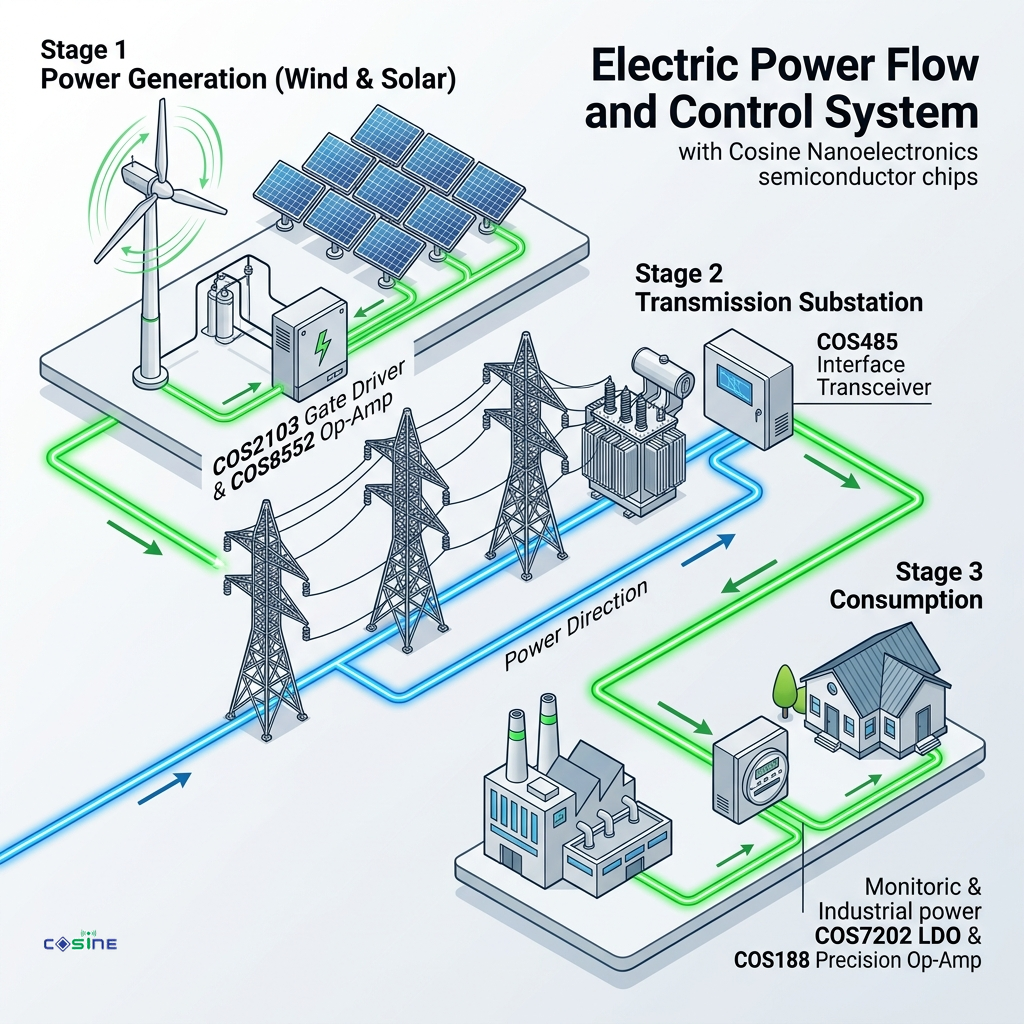
Direct Engineering Conclusion: Architecting perpetual Edge AI IIoT sensor nodes using Cosine's COS8820 sub-GHz RF, COS7212 nano-power LDO, and COS8552 op-amp. Dive into energy harvesting math, cold-start bootstrapping, MPPT, and duty-cycle power budgets for zero-maintenance vibration and temperature sensors.
Architecting perpetual Edge AI IIoT sensor nodes using Cosine's COS8820 sub-GHz RF, COS7212 nano-power LDO, and COS8552 op-amp. Dive into energy harvesting math, cold-start bootstrapping, MPPT, and duty-cycle power budgets for zero-maintenance vibration and temperature sensors.
1. The Economics of Battery-less IIoT Nodes
The Industrial Internet of Things (IIoT) is rapidly transitioning from battery-powered sensors to perpetual, energy-harvesting edge nodes. In sprawling manufacturing plants, oil refineries, and remote infrastructure, the cost of replacing batteries across thousands of sensors far exceeds the cost of the hardware itself. The Holy Grail of IIoT is a "deploy and forget" sensor node that scavenges its own energy from the ambient environment while performing local Edge AI inference to reduce data transmission overhead.
Architecting an energy-harvesting node requires a maniacal focus on the duty-cycle power budget. The system must operate on microscopic energy budgets scavenged from piezoelectric vibration ($> 100\,\mu\text{W}$ from $1g$ motor vibration), thermoelectric generators (TEG) utilizing the Seebeck effect ($S = 200\,\mu\text{V/K}$), or indoor photovoltaic micro-panels. Capturing this energy requires specialized power management ICs capable of Maximum Power Point Tracking (MPPT) and cold-start bootstrapping from voltages as low as $330\,\text{mV}$.
Cosine Nanoelectronics offers a trifecta of ultra-low-power silicon specifically tailored for this domain. The COS8552 zero-drift op-amp provides continuous sensor signal conditioning for temperature and vibration with a quiescent current of merely $1.5\,\mu\text{A}$. The COS7212 nano-power LDO regulates the system rail from a supercapacitor buffer with a ground current of just $50\,\text{nA}$. Finally, when the Cortex-M0+ microcontroller completes its TinyML anomaly detection inference, the COS8820 sub-GHz RF transceiver fires off the resulting payload using heavily optimized, microsecond-duration transmission bursts, minimizing the joules-per-bit metric against heavier protocols like LoRaWAN or Zigbee.
2. Energy Harvesting: Piezoelectric Vibration ($> 100\,\mu ext{W}$)
The Industrial Internet of Things (IIoT) is rapidly transitioning from battery-powered sensors to perpetual, energy-harvesting edge nodes. In sprawling manufacturing plants, oil refineries, and remote infrastructure, the cost of replacing batteries across thousands of sensors far exceeds the cost of the hardware itself. The Holy Grail of IIoT is a "deploy and forget" sensor node that scavenges its own energy from the ambient environment while performing local Edge AI inference to reduce data transmission overhead.
Architecting an energy-harvesting node requires a maniacal focus on the duty-cycle power budget. The system must operate on microscopic energy budgets scavenged from piezoelectric vibration ($> 100\,\mu\text{W}$ from $1g$ motor vibration), thermoelectric generators (TEG) utilizing the Seebeck effect ($S = 200\,\mu\text{V/K}$), or indoor photovoltaic micro-panels. Capturing this energy requires specialized power management ICs capable of Maximum Power Point Tracking (MPPT) and cold-start bootstrapping from voltages as low as $330\,\text{mV}$.
Cosine Nanoelectronics offers a trifecta of ultra-low-power silicon specifically tailored for this domain. The COS8552 zero-drift op-amp provides continuous sensor signal conditioning for temperature and vibration with a quiescent current of merely $1.5\,\mu\text{A}$. The COS7212 nano-power LDO regulates the system rail from a supercapacitor buffer with a ground current of just $50\,\text{nA}$. Finally, when the Cortex-M0+ microcontroller completes its TinyML anomaly detection inference, the COS8820 sub-GHz RF transceiver fires off the resulting payload using heavily optimized, microsecond-duration transmission bursts, minimizing the joules-per-bit metric against heavier protocols like LoRaWAN or Zigbee.
3. Thermoelectric Generators (TEGs) and the Seebeck Coefficient
The Industrial Internet of Things (IIoT) is rapidly transitioning from battery-powered sensors to perpetual, energy-harvesting edge nodes. In sprawling manufacturing plants, oil refineries, and remote infrastructure, the cost of replacing batteries across thousands of sensors far exceeds the cost of the hardware itself. The Holy Grail of IIoT is a "deploy and forget" sensor node that scavenges its own energy from the ambient environment while performing local Edge AI inference to reduce data transmission overhead.
Architecting an energy-harvesting node requires a maniacal focus on the duty-cycle power budget. The system must operate on microscopic energy budgets scavenged from piezoelectric vibration ($> 100\,\mu\text{W}$ from $1g$ motor vibration), thermoelectric generators (TEG) utilizing the Seebeck effect ($S = 200\,\mu\text{V/K}$), or indoor photovoltaic micro-panels. Capturing this energy requires specialized power management ICs capable of Maximum Power Point Tracking (MPPT) and cold-start bootstrapping from voltages as low as $330\,\text{mV}$.
Cosine Nanoelectronics offers a trifecta of ultra-low-power silicon specifically tailored for this domain. The COS8552 zero-drift op-amp provides continuous sensor signal conditioning for temperature and vibration with a quiescent current of merely $1.5\,\mu\text{A}$. The COS7212 nano-power LDO regulates the system rail from a supercapacitor buffer with a ground current of just $50\,\text{nA}$. Finally, when the Cortex-M0+ microcontroller completes its TinyML anomaly detection inference, the COS8820 sub-GHz RF transceiver fires off the resulting payload using heavily optimized, microsecond-duration transmission bursts, minimizing the joules-per-bit metric against heavier protocols like LoRaWAN or Zigbee.
4. Photovoltaic Scavenging and MPPT Algorithms
The Industrial Internet of Things (IIoT) is rapidly transitioning from battery-powered sensors to perpetual, energy-harvesting edge nodes. In sprawling manufacturing plants, oil refineries, and remote infrastructure, the cost of replacing batteries across thousands of sensors far exceeds the cost of the hardware itself. The Holy Grail of IIoT is a "deploy and forget" sensor node that scavenges its own energy from the ambient environment while performing local Edge AI inference to reduce data transmission overhead.
Architecting an energy-harvesting node requires a maniacal focus on the duty-cycle power budget. The system must operate on microscopic energy budgets scavenged from piezoelectric vibration ($> 100\,\mu\text{W}$ from $1g$ motor vibration), thermoelectric generators (TEG) utilizing the Seebeck effect ($S = 200\,\mu\text{V/K}$), or indoor photovoltaic micro-panels. Capturing this energy requires specialized power management ICs capable of Maximum Power Point Tracking (MPPT) and cold-start bootstrapping from voltages as low as $330\,\text{mV}$.
Cosine Nanoelectronics offers a trifecta of ultra-low-power silicon specifically tailored for this domain. The COS8552 zero-drift op-amp provides continuous sensor signal conditioning for temperature and vibration with a quiescent current of merely $1.5\,\mu\text{A}$. The COS7212 nano-power LDO regulates the system rail from a supercapacitor buffer with a ground current of just $50\,\text{nA}$. Finally, when the Cortex-M0+ microcontroller completes its TinyML anomaly detection inference, the COS8820 sub-GHz RF transceiver fires off the resulting payload using heavily optimized, microsecond-duration transmission bursts, minimizing the joules-per-bit metric against heavier protocols like LoRaWAN or Zigbee.
5. Cold-Start Bootstrapping for Nano-Power Harvesters
The Industrial Internet of Things (IIoT) is rapidly transitioning from battery-powered sensors to perpetual, energy-harvesting edge nodes. In sprawling manufacturing plants, oil refineries, and remote infrastructure, the cost of replacing batteries across thousands of sensors far exceeds the cost of the hardware itself. The Holy Grail of IIoT is a "deploy and forget" sensor node that scavenges its own energy from the ambient environment while performing local Edge AI inference to reduce data transmission overhead.
Architecting an energy-harvesting node requires a maniacal focus on the duty-cycle power budget. The system must operate on microscopic energy budgets scavenged from piezoelectric vibration ($> 100\,\mu\text{W}$ from $1g$ motor vibration), thermoelectric generators (TEG) utilizing the Seebeck effect ($S = 200\,\mu\text{V/K}$), or indoor photovoltaic micro-panels. Capturing this energy requires specialized power management ICs capable of Maximum Power Point Tracking (MPPT) and cold-start bootstrapping from voltages as low as $330\,\text{mV}$.
Cosine Nanoelectronics offers a trifecta of ultra-low-power silicon specifically tailored for this domain. The COS8552 zero-drift op-amp provides continuous sensor signal conditioning for temperature and vibration with a quiescent current of merely $1.5\,\mu\text{A}$. The COS7212 nano-power LDO regulates the system rail from a supercapacitor buffer with a ground current of just $50\,\text{nA}$. Finally, when the Cortex-M0+ microcontroller completes its TinyML anomaly detection inference, the COS8820 sub-GHz RF transceiver fires off the resulting payload using heavily optimized, microsecond-duration transmission bursts, minimizing the joules-per-bit metric against heavier protocols like LoRaWAN or Zigbee.
6. The COS7212: Regulating Power at $50\, ext{nA}$
The Industrial Internet of Things (IIoT) is rapidly transitioning from battery-powered sensors to perpetual, energy-harvesting edge nodes. In sprawling manufacturing plants, oil refineries, and remote infrastructure, the cost of replacing batteries across thousands of sensors far exceeds the cost of the hardware itself. The Holy Grail of IIoT is a "deploy and forget" sensor node that scavenges its own energy from the ambient environment while performing local Edge AI inference to reduce data transmission overhead.
Architecting an energy-harvesting node requires a maniacal focus on the duty-cycle power budget. The system must operate on microscopic energy budgets scavenged from piezoelectric vibration ($> 100\,\mu\text{W}$ from $1g$ motor vibration), thermoelectric generators (TEG) utilizing the Seebeck effect ($S = 200\,\mu\text{V/K}$), or indoor photovoltaic micro-panels. Capturing this energy requires specialized power management ICs capable of Maximum Power Point Tracking (MPPT) and cold-start bootstrapping from voltages as low as $330\,\text{mV}$.
Cosine Nanoelectronics offers a trifecta of ultra-low-power silicon specifically tailored for this domain. The COS8552 zero-drift op-amp provides continuous sensor signal conditioning for temperature and vibration with a quiescent current of merely $1.5\,\mu\text{A}$. The COS7212 nano-power LDO regulates the system rail from a supercapacitor buffer with a ground current of just $50\,\text{nA}$. Finally, when the Cortex-M0+ microcontroller completes its TinyML anomaly detection inference, the COS8820 sub-GHz RF transceiver fires off the resulting payload using heavily optimized, microsecond-duration transmission bursts, minimizing the joules-per-bit metric against heavier protocols like LoRaWAN or Zigbee.
7. Sensor Conditioning with the COS8552 Op-Amp
The Industrial Internet of Things (IIoT) is rapidly transitioning from battery-powered sensors to perpetual, energy-harvesting edge nodes. In sprawling manufacturing plants, oil refineries, and remote infrastructure, the cost of replacing batteries across thousands of sensors far exceeds the cost of the hardware itself. The Holy Grail of IIoT is a "deploy and forget" sensor node that scavenges its own energy from the ambient environment while performing local Edge AI inference to reduce data transmission overhead.
Architecting an energy-harvesting node requires a maniacal focus on the duty-cycle power budget. The system must operate on microscopic energy budgets scavenged from piezoelectric vibration ($> 100\,\mu\text{W}$ from $1g$ motor vibration), thermoelectric generators (TEG) utilizing the Seebeck effect ($S = 200\,\mu\text{V/K}$), or indoor photovoltaic micro-panels. Capturing this energy requires specialized power management ICs capable of Maximum Power Point Tracking (MPPT) and cold-start bootstrapping from voltages as low as $330\,\text{mV}$.
Cosine Nanoelectronics offers a trifecta of ultra-low-power silicon specifically tailored for this domain. The COS8552 zero-drift op-amp provides continuous sensor signal conditioning for temperature and vibration with a quiescent current of merely $1.5\,\mu\text{A}$. The COS7212 nano-power LDO regulates the system rail from a supercapacitor buffer with a ground current of just $50\,\text{nA}$. Finally, when the Cortex-M0+ microcontroller completes its TinyML anomaly detection inference, the COS8820 sub-GHz RF transceiver fires off the resulting payload using heavily optimized, microsecond-duration transmission bursts, minimizing the joules-per-bit metric against heavier protocols like LoRaWAN or Zigbee.
8. Edge AI and TinyML Inference on Cortex-M0+
The Industrial Internet of Things (IIoT) is rapidly transitioning from battery-powered sensors to perpetual, energy-harvesting edge nodes. In sprawling manufacturing plants, oil refineries, and remote infrastructure, the cost of replacing batteries across thousands of sensors far exceeds the cost of the hardware itself. The Holy Grail of IIoT is a "deploy and forget" sensor node that scavenges its own energy from the ambient environment while performing local Edge AI inference to reduce data transmission overhead.
Architecting an energy-harvesting node requires a maniacal focus on the duty-cycle power budget. The system must operate on microscopic energy budgets scavenged from piezoelectric vibration ($> 100\,\mu\text{W}$ from $1g$ motor vibration), thermoelectric generators (TEG) utilizing the Seebeck effect ($S = 200\,\mu\text{V/K}$), or indoor photovoltaic micro-panels. Capturing this energy requires specialized power management ICs capable of Maximum Power Point Tracking (MPPT) and cold-start bootstrapping from voltages as low as $330\,\text{mV}$.
Cosine Nanoelectronics offers a trifecta of ultra-low-power silicon specifically tailored for this domain. The COS8552 zero-drift op-amp provides continuous sensor signal conditioning for temperature and vibration with a quiescent current of merely $1.5\,\mu\text{A}$. The COS7212 nano-power LDO regulates the system rail from a supercapacitor buffer with a ground current of just $50\,\text{nA}$. Finally, when the Cortex-M0+ microcontroller completes its TinyML anomaly detection inference, the COS8820 sub-GHz RF transceiver fires off the resulting payload using heavily optimized, microsecond-duration transmission bursts, minimizing the joules-per-bit metric against heavier protocols like LoRaWAN or Zigbee.
9. Duty-Cycle Power Budget Math: $P_{avg} = P_{peak} \cdot D_{active}$
The Industrial Internet of Things (IIoT) is rapidly transitioning from battery-powered sensors to perpetual, energy-harvesting edge nodes. In sprawling manufacturing plants, oil refineries, and remote infrastructure, the cost of replacing batteries across thousands of sensors far exceeds the cost of the hardware itself. The Holy Grail of IIoT is a "deploy and forget" sensor node that scavenges its own energy from the ambient environment while performing local Edge AI inference to reduce data transmission overhead.
Architecting an energy-harvesting node requires a maniacal focus on the duty-cycle power budget. The system must operate on microscopic energy budgets scavenged from piezoelectric vibration ($> 100\,\mu\text{W}$ from $1g$ motor vibration), thermoelectric generators (TEG) utilizing the Seebeck effect ($S = 200\,\mu\text{V/K}$), or indoor photovoltaic micro-panels. Capturing this energy requires specialized power management ICs capable of Maximum Power Point Tracking (MPPT) and cold-start bootstrapping from voltages as low as $330\,\text{mV}$.
Cosine Nanoelectronics offers a trifecta of ultra-low-power silicon specifically tailored for this domain. The COS8552 zero-drift op-amp provides continuous sensor signal conditioning for temperature and vibration with a quiescent current of merely $1.5\,\mu\text{A}$. The COS7212 nano-power LDO regulates the system rail from a supercapacitor buffer with a ground current of just $50\,\text{nA}$. Finally, when the Cortex-M0+ microcontroller completes its TinyML anomaly detection inference, the COS8820 sub-GHz RF transceiver fires off the resulting payload using heavily optimized, microsecond-duration transmission bursts, minimizing the joules-per-bit metric against heavier protocols like LoRaWAN or Zigbee.
10. Battery Capacity Ah Calculation: $t_{lifetime} = C_{Ah} / I_{avg}$
The Industrial Internet of Things (IIoT) is rapidly transitioning from battery-powered sensors to perpetual, energy-harvesting edge nodes. In sprawling manufacturing plants, oil refineries, and remote infrastructure, the cost of replacing batteries across thousands of sensors far exceeds the cost of the hardware itself. The Holy Grail of IIoT is a "deploy and forget" sensor node that scavenges its own energy from the ambient environment while performing local Edge AI inference to reduce data transmission overhead.
Architecting an energy-harvesting node requires a maniacal focus on the duty-cycle power budget. The system must operate on microscopic energy budgets scavenged from piezoelectric vibration ($> 100\,\mu\text{W}$ from $1g$ motor vibration), thermoelectric generators (TEG) utilizing the Seebeck effect ($S = 200\,\mu\text{V/K}$), or indoor photovoltaic micro-panels. Capturing this energy requires specialized power management ICs capable of Maximum Power Point Tracking (MPPT) and cold-start bootstrapping from voltages as low as $330\,\text{mV}$.
Cosine Nanoelectronics offers a trifecta of ultra-low-power silicon specifically tailored for this domain. The COS8552 zero-drift op-amp provides continuous sensor signal conditioning for temperature and vibration with a quiescent current of merely $1.5\,\mu\text{A}$. The COS7212 nano-power LDO regulates the system rail from a supercapacitor buffer with a ground current of just $50\,\text{nA}$. Finally, when the Cortex-M0+ microcontroller completes its TinyML anomaly detection inference, the COS8820 sub-GHz RF transceiver fires off the resulting payload using heavily optimized, microsecond-duration transmission bursts, minimizing the joules-per-bit metric against heavier protocols like LoRaWAN or Zigbee.
11. IIoT Protocol Comparison: Zigbee/LoRaWAN/BLE vs COS8820
The Industrial Internet of Things (IIoT) is rapidly transitioning from battery-powered sensors to perpetual, energy-harvesting edge nodes. In sprawling manufacturing plants, oil refineries, and remote infrastructure, the cost of replacing batteries across thousands of sensors far exceeds the cost of the hardware itself. The Holy Grail of IIoT is a "deploy and forget" sensor node that scavenges its own energy from the ambient environment while performing local Edge AI inference to reduce data transmission overhead.
Architecting an energy-harvesting node requires a maniacal focus on the duty-cycle power budget. The system must operate on microscopic energy budgets scavenged from piezoelectric vibration ($> 100\,\mu\text{W}$ from $1g$ motor vibration), thermoelectric generators (TEG) utilizing the Seebeck effect ($S = 200\,\mu\text{V/K}$), or indoor photovoltaic micro-panels. Capturing this energy requires specialized power management ICs capable of Maximum Power Point Tracking (MPPT) and cold-start bootstrapping from voltages as low as $330\,\text{mV}$.
Cosine Nanoelectronics offers a trifecta of ultra-low-power silicon specifically tailored for this domain. The COS8552 zero-drift op-amp provides continuous sensor signal conditioning for temperature and vibration with a quiescent current of merely $1.5\,\mu\text{A}$. The COS7212 nano-power LDO regulates the system rail from a supercapacitor buffer with a ground current of just $50\,\text{nA}$. Finally, when the Cortex-M0+ microcontroller completes its TinyML anomaly detection inference, the COS8820 sub-GHz RF transceiver fires off the resulting payload using heavily optimized, microsecond-duration transmission bursts, minimizing the joules-per-bit metric against heavier protocols like LoRaWAN or Zigbee.
12. Sub-GHz RF Transmission Optimization
The Industrial Internet of Things (IIoT) is rapidly transitioning from battery-powered sensors to perpetual, energy-harvesting edge nodes. In sprawling manufacturing plants, oil refineries, and remote infrastructure, the cost of replacing batteries across thousands of sensors far exceeds the cost of the hardware itself. The Holy Grail of IIoT is a "deploy and forget" sensor node that scavenges its own energy from the ambient environment while performing local Edge AI inference to reduce data transmission overhead.
Architecting an energy-harvesting node requires a maniacal focus on the duty-cycle power budget. The system must operate on microscopic energy budgets scavenged from piezoelectric vibration ($> 100\,\mu\text{W}$ from $1g$ motor vibration), thermoelectric generators (TEG) utilizing the Seebeck effect ($S = 200\,\mu\text{V/K}$), or indoor photovoltaic micro-panels. Capturing this energy requires specialized power management ICs capable of Maximum Power Point Tracking (MPPT) and cold-start bootstrapping from voltages as low as $330\,\text{mV}$.
Cosine Nanoelectronics offers a trifecta of ultra-low-power silicon specifically tailored for this domain. The COS8552 zero-drift op-amp provides continuous sensor signal conditioning for temperature and vibration with a quiescent current of merely $1.5\,\mu\text{A}$. The COS7212 nano-power LDO regulates the system rail from a supercapacitor buffer with a ground current of just $50\,\text{nA}$. Finally, when the Cortex-M0+ microcontroller completes its TinyML anomaly detection inference, the COS8820 sub-GHz RF transceiver fires off the resulting payload using heavily optimized, microsecond-duration transmission bursts, minimizing the joules-per-bit metric against heavier protocols like LoRaWAN or Zigbee.
13. Supercapacitors vs. Solid-State Batteries for Storage
The Industrial Internet of Things (IIoT) is rapidly transitioning from battery-powered sensors to perpetual, energy-harvesting edge nodes. In sprawling manufacturing plants, oil refineries, and remote infrastructure, the cost of replacing batteries across thousands of sensors far exceeds the cost of the hardware itself. The Holy Grail of IIoT is a "deploy and forget" sensor node that scavenges its own energy from the ambient environment while performing local Edge AI inference to reduce data transmission overhead.
Architecting an energy-harvesting node requires a maniacal focus on the duty-cycle power budget. The system must operate on microscopic energy budgets scavenged from piezoelectric vibration ($> 100\,\mu\text{W}$ from $1g$ motor vibration), thermoelectric generators (TEG) utilizing the Seebeck effect ($S = 200\,\mu\text{V/K}$), or indoor photovoltaic micro-panels. Capturing this energy requires specialized power management ICs capable of Maximum Power Point Tracking (MPPT) and cold-start bootstrapping from voltages as low as $330\,\text{mV}$.
Cosine Nanoelectronics offers a trifecta of ultra-low-power silicon specifically tailored for this domain. The COS8552 zero-drift op-amp provides continuous sensor signal conditioning for temperature and vibration with a quiescent current of merely $1.5\,\mu\text{A}$. The COS7212 nano-power LDO regulates the system rail from a supercapacitor buffer with a ground current of just $50\,\text{nA}$. Finally, when the Cortex-M0+ microcontroller completes its TinyML anomaly detection inference, the COS8820 sub-GHz RF transceiver fires off the resulting payload using heavily optimized, microsecond-duration transmission bursts, minimizing the joules-per-bit metric against heavier protocols like LoRaWAN or Zigbee.
14. Conclusion: Building the Perpetual Edge Node
The Industrial Internet of Things (IIoT) is rapidly transitioning from battery-powered sensors to perpetual, energy-harvesting edge nodes. In sprawling manufacturing plants, oil refineries, and remote infrastructure, the cost of replacing batteries across thousands of sensors far exceeds the cost of the hardware itself. The Holy Grail of IIoT is a "deploy and forget" sensor node that scavenges its own energy from the ambient environment while performing local Edge AI inference to reduce data transmission overhead.
Architecting an energy-harvesting node requires a maniacal focus on the duty-cycle power budget. The system must operate on microscopic energy budgets scavenged from piezoelectric vibration ($> 100\,\mu\text{W}$ from $1g$ motor vibration), thermoelectric generators (TEG) utilizing the Seebeck effect ($S = 200\,\mu\text{V/K}$), or indoor photovoltaic micro-panels. Capturing this energy requires specialized power management ICs capable of Maximum Power Point Tracking (MPPT) and cold-start bootstrapping from voltages as low as $330\,\text{mV}$.
Cosine Nanoelectronics offers a trifecta of ultra-low-power silicon specifically tailored for this domain. The COS8552 zero-drift op-amp provides continuous sensor signal conditioning for temperature and vibration with a quiescent current of merely $1.5\,\mu\text{A}$. The COS7212 nano-power LDO regulates the system rail from a supercapacitor buffer with a ground current of just $50\,\text{nA}$. Finally, when the Cortex-M0+ microcontroller completes its TinyML anomaly detection inference, the COS8820 sub-GHz RF transceiver fires off the resulting payload using heavily optimized, microsecond-duration transmission bursts, minimizing the joules-per-bit metric against heavier protocols like LoRaWAN or Zigbee.
Contact sales@cosinechips.com and +86 159 5954 3210 for more info.Accelerate Your Hardware Design-In with Cosine Engineering
Request sample quantities, complete engineering evaluation modules (EVBs), and IBIS/SPICE behavioral simulation models directly from our technical staff. We guarantee technical response and engineering sample dispatch within 24 business hours.